
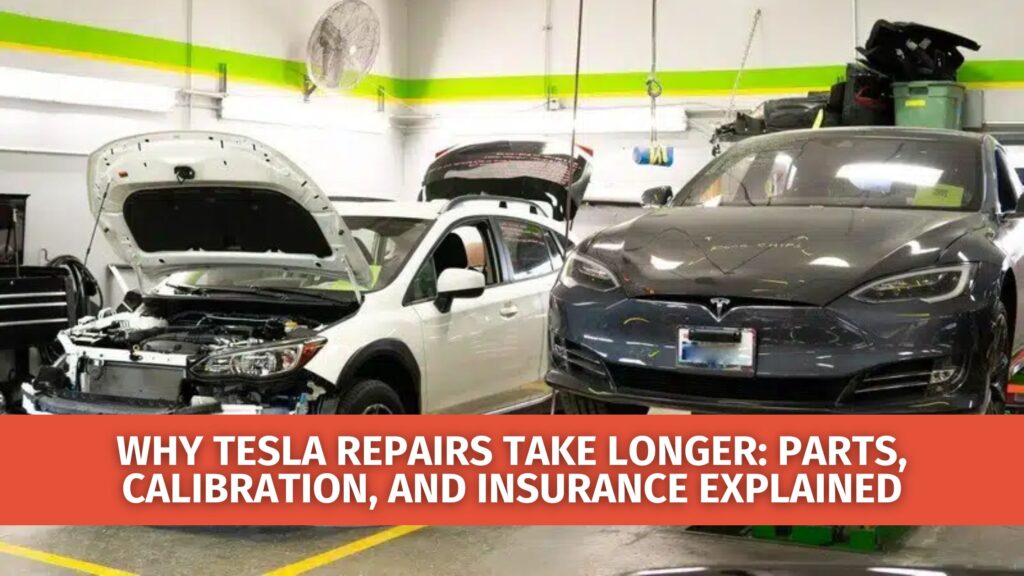
Your Tesla’s been at the body shop for three weeks and the estimate keeps sliding. You’re not imagining it. Tesla repair timelines really do run longer than a typical gas car, and it comes down to three things: parts, sensor calibration, and how insurance handles EV claims.
We work on Teslas every week at Universal Motorcars LV. Customers want to know why a repair takes the time it takes, not just a vague date. So here’s the real breakdown, section by section. If your vehicle needs anything beyond a scratch buff, most of it falls under our collision repair and body paint services, which is where this whole process usually starts.
1. Parts Availability Is the First Bottleneck
Legacy automakers-built decades-deep parts networks. Tesla hasn’t gotten there yet, and that gap shows up on your repair ticket.
Fewer distribution points. Body panels, sensor housings, and battery-adjacent hardware aren’t stocked regionally the way a Camry bumper is. A part might sit in a warehouse three states away.
Demand keeps outrunning supply. Tesla’s sales have grown faster than its parts production. Newer models and mid-cycle refresh trims get backordered for weeks – sometimes longer.
Aftermarket options barely exist. Other brands let a shop grab a decent aftermarket panel and keep moving. Tesla mostly locks you into OEM, especially for anything structural or safety related. That closes off the shortcut other repairs rely on. When a hood, quarter panel, or trunk lid needs full replacement rather than a patch job, that’s complete body repair territory, and it’s exactly where Tesla’s slim parts pipeline hurts the most.
2. ADAS Calibration Catches Most Drivers Off Guard
This is the part nobody warns you about. Cameras, radar, and ultrasonic sensors – depending on your model and year – feed a tightly wired system that runs Autopilot, parking assist, and automatic braking. Touch the front fascia, rear fascia, windshield, mirrors, or suspension, and that whole network can drift out of alignment. A huge chunk of this sensor housing sits behind the front and rear fascias, so bumper repair and replacement jobs almost always trigger a calibration step most owners never see coming on a gas car.
Two calibration types usually follow:
- Static calibration – done in the shop, using calibration targets and dedicated equipment.
- Dynamic calibration – the car gets driven under specific conditions so the sensors relearn the road in real time.
Both take trained hands. Not every shop owns the equipment. Skip the step to save an afternoon, and you risk lane-keeping assist or emergency braking reading the world wrong later – a trade most owners wouldn’t make if they understood it. That single step can add a full day or more to a repair that would otherwise wrap up fast. Structural damage complicates things further, too – frame straightening work shifts suspension geometry just enough that cameras and radar need to be re-taught where “straight ahead” actually is.
3. Insurance Claims Move Differently for EVs
The third piece tangles with both of the above.
Fewer adjusters know EV damage well. Most carriers are still building out staff who understand how to assess a Tesla after a crash, and that unfamiliarity slows approvals.
High-voltage checks come first. Nothing structural happens until the battery and high-voltage system get cleared as safe to work around. That’s a hard stop, not a formality. If your Tesla also needs cosmetic work once the structural side clears, our auto painting and refinishing team handles factory-match finishes so panel colors don’t stand out after the repair.
Supplemental claims are the norm, not the exception. Once a shop opens the car up, hidden damage around sensor housings or battery mounts often turns up. That means a second claim, and a wait for the insurer to sign off before work resumes. Working with a shop that already knows what documentation adjusters want cuts a lot of that back-and-forth.

What This Means If You’re the One Waiting
None of this means your shop is dragging its feet. Tesla repair is just a more complicated job than a standard collision fix. A few things help:
- Pick a shop with EV experience and calibration equipment already on-site.
- Ask about parts lead times for your exact model before work starts.
- Respond fast to your insurer – supplemental claims move only as quick as you do.
Curious what any of this actually costs or how it applies to warranty coverage? Our FAQs page covers the questions we hear most, from pricing transparency to how long a warranty lasts on collision work.
If you’re in Las Vegas and want your Tesla repaired right the first time – proper OEM parts, in-house calibration, and a team that knows EV insurance paperwork – get a free quote from Universal Motorcars LV. We’ll walk you through a realistic timeline before a single tool touches your car.
Frequently Asked Questions
How long does a typical Tesla repair take compared to a gas car?
Minor cosmetic work runs about the same either way. Once sensors, fascias, or structural panels get involved, expect it to stretch – anywhere from a few days to a few weeks, depending on the damage and what needs to be reordered.
Why does my Tesla need calibration after a simple bumper repair?
Because the bumper and fascia house the cameras, radar, and ultrasonic sensors that power Autopilot and collision-avoidance features. Move them even slightly and the car needs static and/or dynamic calibration to read the road correctly again.
Can I use aftermarket parts to speed up my Tesla repair?
Usually not. Structural and safety-critical parts on a Tesla almost always require OEM, since approved aftermarket alternatives are limited or unavailable.
Will my insurance cover the full cost of a Tesla repair?
Most policies do, but supplemental claims are common once hidden damage surfaces during teardown. A shop experienced with EV insurance paperwork can shorten the approval wait.
Is it safe to drive a Tesla that hasn’t been recalibrated after a repair?
No we wouldn’t recommend it. Skipping calibration can throw off automatic emergency braking, lane-keeping assist, and parking sensors, all of which depend on properly aligned cameras.
Does Universal Motorcars LV offer Tesla calibration in-house?
Yes. We calibrate on-site right after the repair, which skips the extra delay of sending the car to a third-party facility.
How can I get an accurate repair timeline for my Tesla?
Bring it in for an in-person estimate. We’ll check parts availability and calibration needs upfront so you’re not left guessing, contact us to schedule one.