
What happens when you try to start?
These details help separate a battery concern from a starting, charging, or engine problem:
- The engine turns slowly: Battery condition and charge, cable connections, and the starting circuit may need checking.
- You hear clicking, but the engine does not turn: A weak power supply or a connection or starter-circuit issue can produce similar symptoms.
- The engine turns normally but will not start: The cause may be elsewhere. Tell us exactly what the vehicle does rather than assuming it needs a battery.
- It starts after a jump, then fails again: The battery may be discharged or deteriorated, or there may be a charging problem or an unwanted electrical draw.
- The battery-shaped warning stays on with the engine running: On many vehicles this points to a charging-system concern. Replacing the battery alone may leave the problem unresolved.
Testing before choosing a replacement
A battery can be low on charge without having reached the end of its useful life. Diagnosis needs to consider both its condition and why it became discharged.
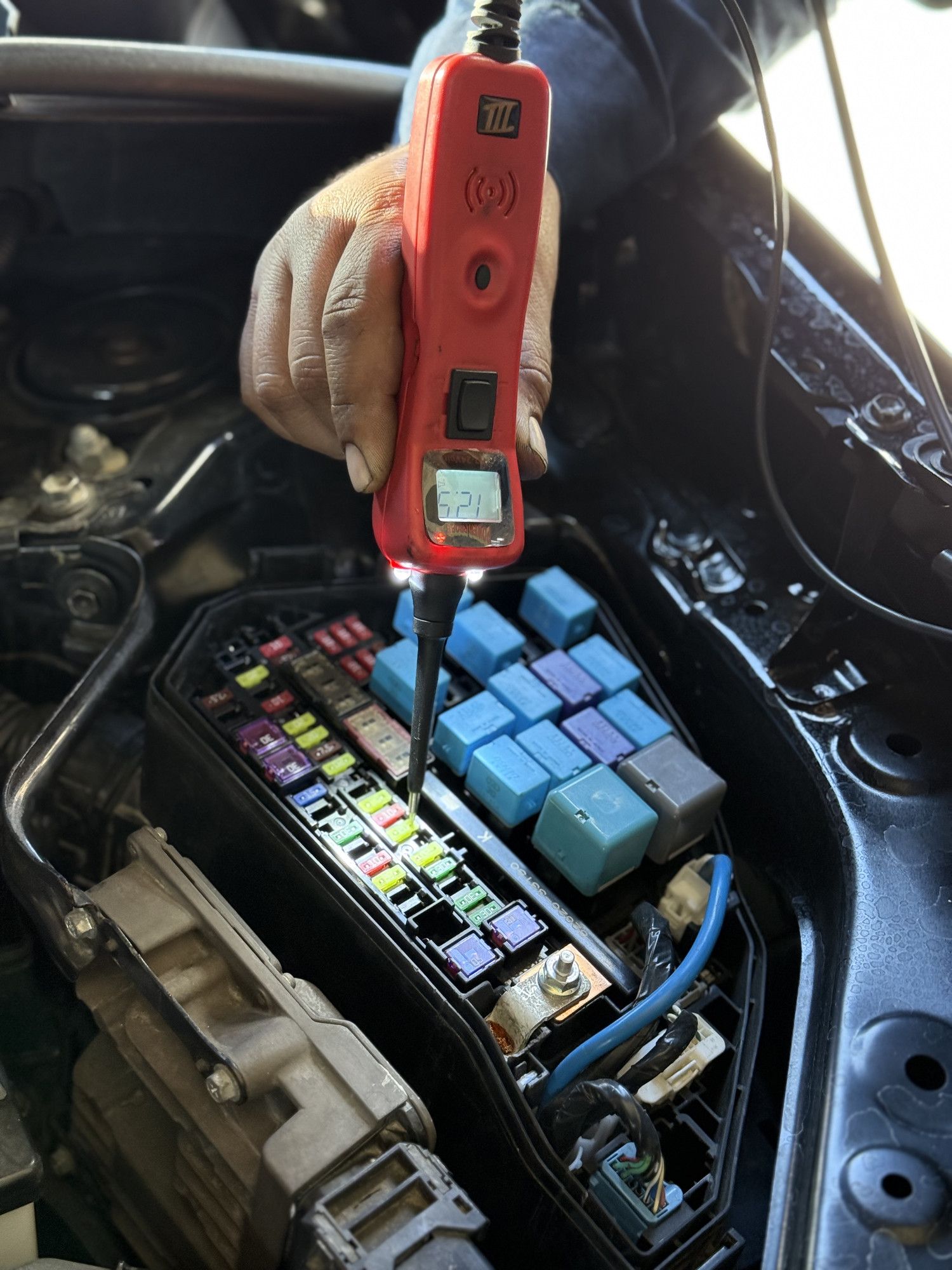
Depending on the complaint, checks may include the battery’s condition and performance, cable and terminal connections, starting-system behavior, and charging operation. A battery may need appropriate charging before a useful retest. If it repeatedly goes flat while parked, further electrical diagnosis may be needed.
Tell us about a dash camera, alarm, audio equipment, or another accessory added recently, and how long the car normally sits between drives. Ask about the testing scope and any charge when scheduling. We discuss the findings and recommendation before you authorize a repair.
Have a vehicle service contract for your electrical concern? Our extended warranty repair process explains diagnosis, claim documentation and customer authorization.
Electrical concerns beyond the battery
Flickering lights, an accessory that cuts out, or several warnings appearing together can have different causes. Tell us which functions are affected, when it happens, and whether it followed a repair or an accessory installation.
Depending on the complaint, diagnosis may include checking the affected circuit’s power supply, ground connections, fuses, and wiring connections, along with relevant fault information. The goal is to connect the symptom with its cause before choosing a part.
Intermittent faults can take time to reproduce. A photo of the warning and a description of the conditions can help; record them only when safely parked.
The replacement needs to match the vehicle
Battery selection involves more than physical size. The specified battery type, capacity, terminal arrangement, and installation requirements matter. Vehicles with stop-start systems may require a particular battery specification.
Some vehicles also need a battery-management reset or registration procedure after replacement. The requirements depend on the exact vehicle. Let us know the year, make, model, and engine when you call so we can discuss the appropriate service.
Hot weather can be hard on a conventional car battery, but age or a Las Vegas summer alone does not establish that replacement is necessary. Symptoms and test findings should guide the decision.
Already replaced it, but it keeps dying?
Bring the previous invoice and tell us whether the failure happens overnight, after several days parked, or during a drive. A new battery does not eliminate the possibility of a poor connection, a charging fault, or an electrical load that stays active.
An excessive electrical load while parked is often called a parasitic drain. Some power use is normal; testing needs to account for the vehicle’s systems and how they settle into their parked state.
Intermittent discharge can take time to reproduce. Avoid clearing the history by repeatedly disconnecting components before the appointment unless the vehicle’s safety instructions require it. Read more about why a battery can keep dying after replacement.
Cost, timing, and what to bring
Battery type, installation access, vehicle-specific setup, and any additional diagnosis affect the price. A straightforward replacement and a recurring electrical fault are different jobs. Ask for the testing charge, replacement estimate if needed, and available appointment time.
Bring the mileage, previous battery receipt, approximate battery age if known, and a photo of any warning message. Tell us whether the vehicle currently starts. If you are stranded, confirm how the vehicle will reach the shop before arranging the visit.
General passenger-vehicle electrical and battery service is at Spring Mountain. Tesla low-voltage battery concerns can be evaluated at Spring Mountain or Post Road; use our Tesla low-voltage battery page and confirm the location. If the engine cranks normally but does not start, see engine repair and diagnostics.
Questions before you book
Does a jump-start prove the battery is bad?
No. It shows that added electrical power helped at that moment. Testing is still needed to evaluate the battery and identify why it was discharged.
Can a dead battery be recharged?
Sometimes. Whether charging is appropriate depends on the battery’s condition and the vehicle’s requirements. A damaged battery should not be charged or jump-started. Testing after appropriate charging helps determine the next step.
What if my car will not start?
Call 702-754-6774 before arranging assistance or bringing in a non-running vehicle. Ask about available service and how to get the vehicle to our Spring Mountain shop.