
Your engine has a secret choreographer. Every piston fire, every valve opens and closes, and every rotation of the crankshaft happens in a precise sequence. Miss that sequence by fraction, and you’re looking at bent valves, a wrecked engine, or a $4,000-$8,000 repair bill.
That choreographer is either a timing belt or a timing chain. Most drivers don’t know which one their car has. Fewer know when it needs attention.
Here’s what you need to know – and when to act.
What a Timing Belt Actually Does (and Why It Matters)
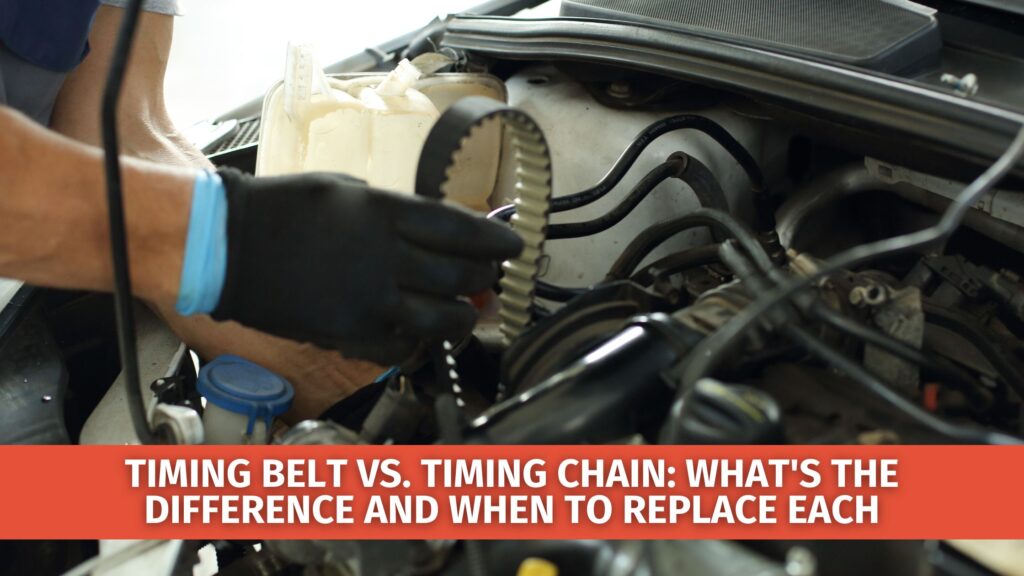
The timing belt is a rubber belt – reinforced with fiber cords – that connects your crankshaft to your camshaft. It keeps the top and bottom halves of your engine synchronized, so intake and exhaust valves open at exactly the right moment during each combustion cycle.
It’s a simple part. But it’s doing a critical job, every second your engine runs.
Timing belts are quiet. They run smooth. You won’t hear them wearing out. That’s part of what makes them dangerous – there’s no warning noise, no dashboard light. One day the belt snaps, and your engine just… stops. Or worse, it doesn’t stop cleanly and the pistons collide with open valves.
Rubber degrades. That’s just physics – and Las Vegas heat accelerates it. At 110°F ambient temps, rubber components age faster than the manufacturer’s lab tests ever modeled. If your car has a timing belt and you’re driving in Clark County summers, stick to the lower end of the replacement window.
What a Timing Chain Does Differently
A timing chain does the same job – synchronizing crankshaft and camshaft – but it’s made of metal links, like a bicycle chain, and it runs inside the engine bathed in oil.
Metal lasts longer than rubber. That’s the core trade-off.
Timing chains are designed to last the life of the engine – 150,000 to 300,000 miles in many cases – assuming the engine is properly maintained. No scheduled replacement interval. No “replace it before it breaks” countdown clock.
But here’s what most people miss: timing chains do wear. They stretch. When a chain stretches, timing gets off by small increments – and those increments show up as rough idling, reduced power, rattling on cold starts, or a check engine light. If you’re in that situation, our engine repair service team can diagnose exactly what’s going on before it gets worse.
Timing Belt vs. Timing Chain: The Real Comparison
| Feature | Timing Belt | Timing Chain |
| Material | Rubber + fiber | Metal links |
| Replacement needed? | Yes – scheduled | Usually no (unless worn) |
| Typical lifespan | 60,000-105,000 miles | 150,000-300,000+ miles |
| Failure warning? | Rarely any | Rattling, rough idle |
| Cost to replace | $300-$1,000+ | $600-$1,800+ |
| Noise level | Quiet | Slightly more noise when worn |
| Las Vegas heat impact | High – degrades rubber faster | Lower – oil-cooled system |

When to Replace a Timing Belt
Manufacturers usually call for replacement every 60,000 to 105,000 miles – check your owner’s manual for the specific number. Don’t go by “how it feels.” You won’t feel it failing.
The smarter move is to replace the water pump, tensioner, and idler pulleys at the same time. They’re driven by the same belt. Replacing just the belt and then having a tensioner fail 6,000 miles later means tearing everything apart again. Labor costs the same whether you replace one part or four.
Signs you might already be late on a timing belt service:
- High mileage with no service records – if you bought a used car and can’t confirm the belt was changed, assume it wasn’t
- Visible cracking or fraying on the belt’s edge (you can sometimes see this with a visual inspection)
- Engine misfires or rough running that gets worse on cold starts
- Ticking noise near the front of the engine, which can indicate a worn tensioner
If your car’s also showing signs of low brake fluid or warning lights on the dashboard, it’s worth getting a full inspection – those issues often come together in high-mileage vehicles.
When to Address a Timing Chain Problem
You won’t replace a timing chain on schedule. But you will replace it when it fails – and that gets expensive if you wait too long.
A new cold-start rattle deserves prompt diagnosis. A chain, tensioner, guide, camshaft adjuster, lubrication issue or another component may be involved. The sound alone does not prove that the chain is stretched or loose, and a noise that fades as the engine warms up can still need attention.
Other symptoms to report during diagnosis include:
- Rough idle that never quite smooths out
- Loss of power on acceleration, especially under load
- Check engine codes P0008, P0009, P0016, P0017 – all related to camshaft/crankshaft timing correlation
- Metal shavings in your oil during an oil change (this is serious – stop driving)
Our auto repair shop carries the diagnostic equipment to read those codes and run a full valve timing test – not just reset the light and send you on your way.
Las Vegas Driving and What It Does to Your Timing System
Most replacement interval data is based on “normal” driving conditions. Las Vegas is not normal driving conditions.
Stop-and-go traffic on the 215, idling for 20 minutes in casino parking structures, ambient heat that soaks the engine bay even when the car’s parked – all of it accelerates wear on rubber components and taxes the lubrication system that keeps timing chains from stretching.
My honest take: if your car has a timing belt and you’re at 55,000 miles, get it inspected. Don’t wait for the 70,000-mile mark because you read that in a forum. Desert heat is a real variable.
And if you’ve been putting off routine car maintenance, the timing system is one area where deferred service can turn a $600 job into an engine replacement. Math doesn’t work in your favor.
Which Cars Have Which?
This trips people up. Here’s a rough guide – but always verify with your owner’s manual or ask a tech:
Generally timing belt engines:
- Honda/Acura (older models – many newer ones switched to chains)
- Toyota/Lexus (4-cylinder models through early 2010s)
- Subaru (many EJ-series engines)
- Volkswagen/Audi (older TDI and 1.8T engines)
Generally timing chain engines:
- Most GM vehicles (Chevy, GMC, Cadillac, Buick)
- Ford (most modern EcoBoost engines)
- BMW (most inline-6 and V8 engines)
- Nissan/Infiniti (most newer models)
- Honda/Toyota newer models (switched from belt to chain)
If your vehicle came in for collision work after an accident, it’s worth checking whether the front-end impact affected any engine accessories or drive components. Our complete auto body repair service includes post-collision mechanical checks for exactly this reason.
What Happens If You Ignore It
Timing belt snaps on interference engines – the pistons hit the open valves. Valves bend. You need a rebuilt head or a new engine.
Timing chain stretches until it skips a tooth. Timing is off. Power drops, misfires start, and eventually the engine won’t start cleanly or won’t start at all.
Neither scenario is cheap. Both are preventable.
Frequently Asked Questions
Q: Can I keep driving if the engine rattles on a cold start?
There is no reliable safe-mileage allowance for an unexplained timing-area rattle. Contact a qualified shop promptly and describe the noise and any warning lights before deciding whether to drive there. Inspection is needed to determine whether the timing system is involved.
If the noise is severe or persistent, or it is accompanied by an oil-pressure warning, significant misfiring or loss of power, stop safely, switch off the engine and arrange a tow. Do not repeatedly restart or accelerate the engine to test it. Follow the vehicle’s specific warning instructions.
Q: How do I know if my car has a timing belt or a timing chain?
Best way: look it up in your owner’s manual under the maintenance schedule. If there’s a listed replacement interval for the “cambelt” or “timing belt,” you have a belt. No interval listed? Likely a chain. You can also ask any mechanic – they’ll know immediately by the make, model, and year.
Q: Does replacing a timing belt include replacing the water pump?
It doesn’t automatically – but it should. The water pump is in the same area, driven by the same belt, and accessing it again after a fresh belt replacement means paying for labor twice. Most shops, including ours, recommend doing both at the same time. It’s a small upcharge relative to the total cost of work.
Q: How much does timing belt replacement cost in Las Vegas?
Expect $400-$900 for most 4-cylinder engines, $700-$1,200+ for V6 and V8 engines, especially when the water pump and tensioners are included. Labor is the biggest variable – timing belt jobs on some Japanese engines are straightforward, while others (Subaru horizontally opposed engines, for instance) take significantly longer to access. Get a written estimate before the work starts.
Get Your Timing System Checked at Universal Motorcars
If you’re not sure when your belt was last replaced – or if you’ve been hearing noises you can’t quite explain – bring it in. We’ll inspect the timing components, pull any stored codes, and give you a straight answer.
Universal Motorcars serves Las Vegas drivers at two locations. Schedule your inspection today before a $600 preventive service turns into a $5,000 engine repair.