
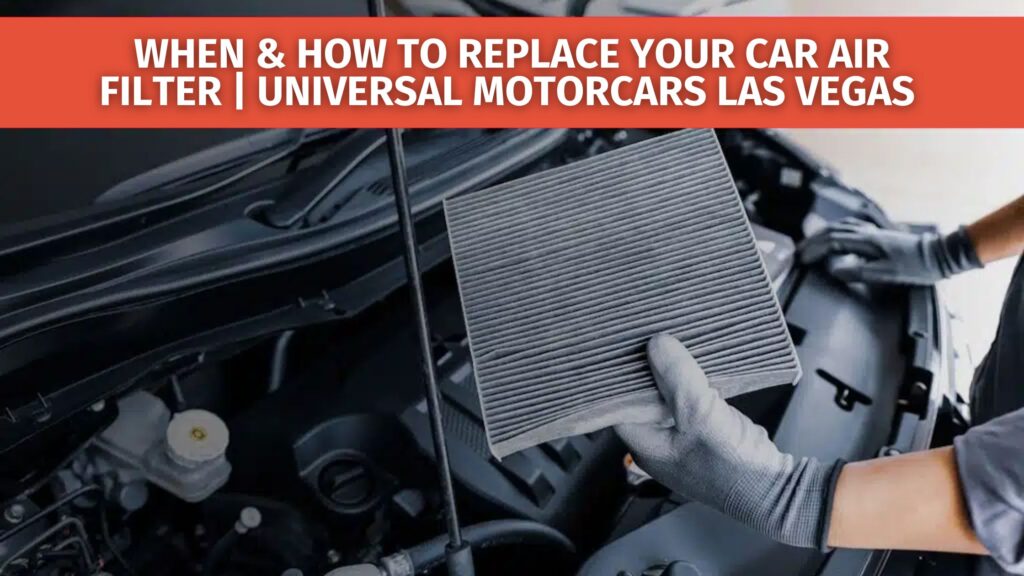
Nobody notices a dirty air filter until the gas bill creeps up. Or the car feels a step slower off the line. There’s no light for it, no warning chime. Just a quiet drag on performance that most people blame on “old car” or “needs a tune-up” – without ever popping the hood to look.
I had a guy last month bring his Civic in for a battery check. Totally unrelated issue. When we opened things up, the air filter looked like it had been sitting in a sandstorm since 2021. Because in Vegas, it basically had been. We see this constantly. A customer’s in for a routine oil change, we lift the hood, and there it is. Caked. Gray. Sometimes you can’t even tell what color the filter started as.
So here’s what this part does. How to tell when it’s done. How to swap it yourself if you want to. And what it costs you if you just… don’t.
What Does a Car Air Filter Actually Do?
An engine needs three things, full stop: fuel, spark, air. That’s it. The air filter’s whole job is guarding the third one. Air gets pulled in every time the engine cycles. Before any of it reaches the combustion chamber, it passes through the filter media – paper, foam, sometimes cotton gauze. Dust, pollen, sand, road grit. None of it’s supposed to get past that point.
Clean filter, clean airflow, engine does what it’s built to do.
Clog it up and the math flips. Less air in means the engine works harder for the same output. That means more fuel burned. Less power actually making it to the wheels.
It’s a cheap part. The job isn’t.
The Signs Are There If You’re Looking
Your dashboard won’t say anything. The car will, though, in its own way.
Hesitation on the gas is usually the first tell. That slight delay when you stomp it merging onto the 215, or pulling out into traffic, and the car just doesn’t quite respond. People often blame the transmission, or even the suspension. Half the time it’s just the filter.
Rough idle, the occasional misfire, a weird shake at a red light. That’s the air-fuel ratio getting thrown off because the filter isn’t letting enough clean air through. Hear coughing or sputtering on a cold start? Same story.
A check engine light can mean fifty different things, sure. But a badly clogged filter can disrupt the mass airflow sensor and trigger it on its own. It’s one of the first things we check during an engine diagnostic. Easy thing to rule out before guessing at bigger problems.
Honestly though? Just pull the filter and look at it. New ones are white, maybe light gray. If yours looks like a chimney sweep’s rag, you’ve got your answer right there.
And then there’s fuel economy. Stopping at the pump more than usual, with nothing else changed about how you drive? A clogged filter forces richer fuel burn to make up for restricted air. At what gas costs in this city right now, that’s not a small leak.
How Often Should You Actually Replace It?
Manufacturers will tell you 12,000 to 15,000 miles under normal conditions. We tell our customers something different – closer to 10,000 to 12,000 – and there’s a reason for the gap that has nothing to do with upselling you.
We’re sitting in the middle of the Mojave Desert. The air here carries fine dust, blowing sand, road grit, pollen – stuff a driver in, say, Portland never has to think about. Spend any real time near the 215, the 95, or any of the dozen work zones across the valley, and your filter takes on more debris per mile than the factory plan ever accounted for.
Heat doesn’t do it any favors either. Triple-digit summers accelerate breakdown of the filter media itself, especially the adhesive seals on the pleated paper ones.
My advice, and what I tell people in the shop: check it every time you’re in for an oil change. Doesn’t cost you anything to look. Saves you from ever being surprised by it.
OEM or Performance – Which One’s Right for You
Two real paths here when it’s time to replace.
OEM filters are built to your vehicle’s exact factory spec. Same dimensions, same filtration density, same airflow rating the engine was tuned around at the factory. It’s the kind of detail our techs check during a full auto repair inspection. If you’re using your car the way most Vegas drivers use theirs – commuting, school runs, errands near the Strip – OEM is the obvious, low-risk choice.
Performance filters, the K&N-style cotton gauze setups, flow more air than a standard paper filter. They can be washed and reused instead of replaced outright. You’ll pick up a little horsepower, usually 1 to 4 on a naturally aspirated engine. About the same small bump you’d get from fresh battery service or a clean set of plugs. Nothing huge. They do need re-oiling and cleaning roughly every 25,000 to 50,000 miles. Worth it if you’ve got a build you’re tuning, or you just like tinkering. Overkill for a daily commuter.
Daily driver, no mods planned? Stick with OEM. Chasing every bit of throttle response you can get? A good performance filter earns its keep.

How to Replace It Yourself
This is about as forgiving a DIY job as your car offers. No lift required. No specialty tools in most cases. Maybe ten minutes if you’re not rushing.
What you’ll need: a new filter matched to your car’s make, model, and year; a clean rag; a screwdriver, depending on your vehicle (some don’t need one at all).
Start by popping the hood and finding the airbox. It’s the black plastic housing near the top of the engine, usually with a wide hose running into it. Open it up. Most use metal spring clips, though some use screws instead. Before you pull the old filter out, note which way it’s seated. Which side faces which way matters more than people expect.
Once it’s out, wipe down the inside of the housing. This step gets skipped more than it should. A fair number of “rough running” complaints we get actually trace back to a loose intake hose connection, not a bad filter. Kind of like “brake” complaints that turn out to be something else once we look. Worth checking while you’re already in there.
Drop the new filter in, same orientation as before. Press it down so it seats firmly against the gasket. Close the housing back up, snap the clips or tighten the screws, and start the engine. Let it idle a minute. Something sound off? Go back and double-check the seal and the hose connection before assuming it’s something bigger.
Total cost: somewhere between $15 and $50 depending on your vehicle and which filter you go with. Total time: genuinely about ten minutes.
What Happens If You Just Never Touch It
This isn’t a minor thing to put off. It compounds.
A severely clogged filter forces the engine to strain for every bit of air it pulls in. That accelerates wear on internal components over time – not a maybe, just physics. It also puts the mass airflow sensor at risk, since that’s the part responsible for measuring incoming air to calculate the right fuel mix. Coat that sensor in debris because the filter stopped doing its job, and now you’re looking at a sensor replacement that runs several hundred dollars. Real number, not a scare tactic.
Push it far enough and you start risking buildup inside the engine too, on top of just general faster wear. None of that shows up when you’re staring at a $20 filter. All of it shows up later on a repair bill that makes the filter look like the deal it was.
One More Filter People Forget About
There’s a second filter most drivers never think about – the cabin air filter. This one has nothing to do with engine performance. It’s entirely about the air coming through your vents into the actual car.
Las Vegas air is dusty and allergen-heavy, basically year-round. A clogged cabin filter means all of that gets pushed straight at your face the second you turn the AC on. It also restricts airflow through the HVAC system, which forces your AC to work harder than it should. Not what you want when it’s 112°F outside and the compressors already maxed out.
Same interval as the engine filter: 12,000 to 15,000 miles. It’s usually tucked behind the glove box, and it takes about as long to swap as the engine filter does.
Or Just Let Us Handle It
If you genuinely don’t know when yours was last changed – and a lot of people don’t – bring it in. We’ll pull it, show you exactly what we’re looking at, and tell you honestly whether it needs replacing or can wait. That’s part of what we do during a full auto repair inspection anyway. No upsell games.
We’re at 5585 Spring Mountain Rd and 3570 W Post Road, open Monday through Friday from 8 AM to 6 PM, Saturday 8 AM to 2 PM.
Call +1 702-754-6774 or just stop by whenever works. A clean air filter is one of the cheapest things you’ll ever do for your engine, and in Vegas heat, your engine needs every advantage it can get.
Frequently Asked Questions
Q1: How often should I replace my car’s engine air filter in Las Vegas?
The textbook’s answer is 12,000 to 15,000 miles. But that number assumes mild, low-dust conditions, not the Mojave. We tell our customers to plan 10,000 to 12,000 miles, or just have it checked at every oil change. Fine desert particulate, construction dust near the 215 and 95, and our brutal summer heat all wear filters down faster here than in a milder climate. Checking it routinely beats guessing.
Q2: What are the warning signs that my air filter is dirty and needs replacing?
Sluggish acceleration is usually what people notice first, especially merging onto the freeway or pulling away from a stop. Beyond that: rough idling, the odd misfire, sputtering on a cold start. In worse cases, a check engine light is caused by a dirty mass airflow sensor. The most reliable test is just visual – pull it out and look. White or light gray means fine. Dark, brown, or caked in debris means it’s overdue.
Q3: Can driving with a clogged air filter actually damage my engine?
Yes, and the longer it goes ignored, the worse it gets. Low airflow forces the engine to strain every intake stroke, speeding up wear on inside parts. It can also let fine dust reach the mass airflow sensor – a fix that typically runs several hundred dollars. We get this question a lot; check our FAQ page for more on common engine concerns. Let it go long enough and you risk buildup inside the engine too. A far costlier problem than the $15 to $50 filter that would’ve stopped it.
Q4: How much does an air filter replacement cost, and can I do it myself?
The part itself runs from $15 to $50 based on your vehicle and whether you go OEM or performance. It’s one of the easiest DIY jobs out there. Find the airbox, pop the clips or screw, swap the filter in the same direction as the old one, and close it back up. Most people are done in under ten minutes with nothing more than a screwdriver. Want it checked while you’re already in for service? Our Spring Mountain and Post Road shops handle it in minutes, no appointment needed.