
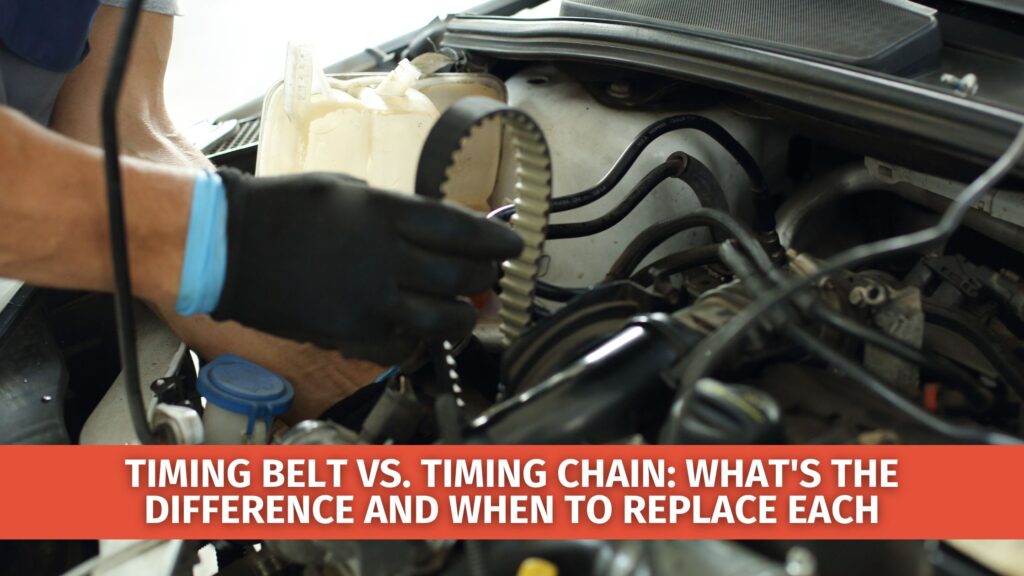
A timing belt or chain keeps the crankshaft and camshaft moving in the correct relationship so the engine’s valves open at the right time. If your car uses a timing belt, follow its vehicle-specific replacement schedule. A timing chain needs attention when diagnosis finds a problem; a noise or fault code alone does not establish that it needs replacement.
Which system your car uses depends on its exact engine, not just the brand. Your service records and manufacturer’s maintenance information are the starting points.
Here’s what you need to know – and when to act.
What a Timing Belt Actually Does (and Why It Matters)
The timing belt is a rubber belt – reinforced with fiber cords – that connects your crankshaft to your camshaft. It keeps the top and bottom halves of your engine synchronized, so intake and exhaust valves open at exactly the right moment during each combustion cycle.
It’s a simple part. But it’s doing a critical job, every second your engine runs.
A timing belt can deteriorate without a warning that the driver notices. Do not wait for a noise or warning light before following its replacement schedule. If the belt breaks or jumps timing, an interference engine can suffer internal damage; inspection determines the actual damage and repair options.
Use the manufacturer’s schedule and any special-condition instructions for your exact engine. Some schedules specify a different interval for sustained extreme temperatures or towing. Las Vegas driving is a reason to check those instructions, not to replace them with an arbitrary mileage rule.
What a Timing Chain Does Differently
A timing chain does the same job – synchronizing crankshaft and camshaft – but it’s made of metal links, like a bicycle chain, and it runs inside the engine bathed in oil.
The chain is part of a system that also includes guides and a tensioner. Its service needs depend on the engine design and condition.
Many timing chains have no routine replacement interval in the maintenance schedule. That does not guarantee a particular lifespan. Use the specified oil and service schedule, and investigate new timing-area noises or fault codes rather than waiting for a failure.
Chain wear, guide or tensioner faults, and other timing-control problems can affect engine operation. Rough idle, reduced power, a cold-start rattle or a check-engine light can also have other causes. Our engine diagnosis and repair service starts by establishing what the symptoms and tests show.
Timing Belt vs. Timing Chain: The Real Comparison
| Question | Timing belt | Timing chain |
|---|---|---|
| Construction | Reinforced belt | Metal links with guides and a tensioner |
| Routine replacement | Use the exact engine’s time, mileage or maintenance-reminder schedule. | Many have no routine replacement interval; check the vehicle’s instructions. |
| Can symptoms identify failure? | No. A belt can deteriorate without an obvious warning. | No. Rattles or fault codes require diagnosis. |
| What affects the estimate? | Access, belt kit, related components, pump design and findings. | Access, chains, guides, tensioners, timing-control parts and findings. |
| Maintenance priority | Document replacement history and follow any specified special-use interval. | Follow the oil specification and maintenance schedule; investigate new symptoms. |

When to Replace a Timing Belt
Check the maintenance schedule for your exact engine, including any time limit, mileage limit, maintenance reminder and special-use conditions. Keep the invoice showing when the belt was replaced. If its history is unknown, discuss the records and required service with the shop; appearance alone cannot establish how much useful life remains.
Ask which tensioners, idlers, seals and other related parts belong in the estimate and why. Some water pumps are driven by the timing belt; others are not. Where access overlaps, servicing related components together can avoid repeating part of the labor. The manufacturer’s procedure, component condition and exact engine determine the scope—labor is not automatically identical for every combination of parts.
Tell the shop about missing service records, visible belt damage, leaks around the timing covers, new noises or rough running. These clues need assessment; they do not all prove that the timing belt is the cause. The timing belt may be behind covers and should not be confused with the visible accessory belt.
When to Address a Timing Chain Problem
Check the vehicle’s service information rather than applying a universal chain-replacement rule. A suspected timing problem should be diagnosed before failure, and the repair recommendation should follow the findings.
A new cold-start rattle deserves prompt diagnosis. A chain, tensioner, guide, camshaft adjuster, lubrication issue or another component may be involved. The sound alone does not prove that the chain is stretched or loose, and a noise that fades as the engine warms up can still need attention.
Other symptoms to report during diagnosis include:
- Rough idle that never quite smooths out
- Loss of power on acceleration, especially under load
- Check engine codes P0008, P0009, P0016, P0017 – timing-related codes that need vehicle-specific diagnosis
- Metal shavings in your oil during an oil change (this is serious – stop driving)
Stored codes are a starting point for diagnosis. Tests depend on the vehicle and may include oil condition and pressure, timing-control operation and mechanical timing checks. A camshaft/crankshaft correlation code alone does not authorize a chain replacement.
Las Vegas Driving and What It Does to Your Timing System
Describe how you use the car: repeated short trips, extended idling, towing and high-temperature driving can matter under the manufacturer’s maintenance instructions.
For example, Honda lists a special timing-belt interval for certain vehicles regularly operated above 110°F, in very low temperatures or while towing. That example does not set the interval for every Las Vegas vehicle. Confirm whether your engine has a comparable instruction.
Bring the year, model, engine information, mileage and any previous timing-service invoice. Those details help the shop identify the correct schedule and whether service is due.
If service is due, plan it from the documented schedule. If the car has new symptoms, start with diagnosis. Routine maintenance and fault diagnosis answer different questions.
Which Cars Have Which?
Confirm the timing system from the VIN and exact engine information. Model names, cylinder counts and broad brand lists are not reliable enough: different engines and model years can use different designs. Check the manufacturer’s maintenance information or ask the shop to verify it.
If the vehicle is also here for collision repairs, tell the team about any new noise, warning or drivability change after the impact. Our auto body repair planning can address related mechanical concerns according to the damage and required repair procedures.
What Happens If You Ignore It
If a belt breaks or a timing system jumps out of position, an interference engine can suffer contact between pistons and valves. The extent of any damage requires inspection; an engine replacement is not an automatic conclusion.
A chain, guide or tensioner fault can disrupt valve timing and cause poor running, a no-start condition or internal damage. Diagnosis should determine the cause and whether the engine can be repaired.
Following the specified service schedule and responding to new symptoms can reduce avoidable risk, but maintenance does not guarantee that every failure can be prevented.
Frequently Asked Questions
Q: Can I keep driving if the engine rattles on a cold start?
There is no reliable safe-mileage allowance for an unexplained timing-area rattle. Contact a qualified shop promptly and describe the noise and any warning lights before deciding whether to drive there. Inspection is needed to determine whether the timing system is involved.
If the noise is severe or persistent, or it is accompanied by an oil-pressure warning, significant misfiring or loss of power, stop safely, switch off the engine and arrange a tow. Do not repeatedly restart or accelerate the engine to test it. Follow the vehicle’s specific warning instructions.
Q: How do I know if my car has a timing belt or a timing chain?
Check the maintenance information for the exact engine or ask the shop to identify it from the VIN and engine details. A missing interval in a brief owner’s guide is not proof that the engine uses a chain. Different engines within the same model can use different timing systems.
Q: Does replacing a timing belt include replacing the water pump?
Not automatically. Check how the water pump is driven, its condition and the manufacturer’s service procedure. When the pump shares timing-belt access, replacing it during belt service may reduce duplicated labor later. Ask the estimate to identify the pump, tensioner, idlers and other included parts rather than assuming they are all covered.
Q: How much does timing belt replacement cost in Las Vegas?
The estimate depends on the exact engine, access required, parts included and any leaks or damage found. Ask for an itemized quote covering the belt or chain components, related parts, fluids, labor and any additional diagnosis. A cylinder count alone is not enough to provide a reliable price.
Get Your Timing System Checked at Universal Motorcars
If the timing-service history is unclear or there is a new noise or warning light, call with your vehicle details. We can discuss the appropriate inspection and confirm the diagnostic scope and charge before arranging the visit.
Passenger-vehicle timing and engine concerns are handled at Universal Motorcars at Spring Mountain, 5585 Spring Mountain Rd, Las Vegas, NV 89146. Call 702-754-6774 or review our engine diagnosis service. Tell us about severe noise, an oil-pressure warning, significant misfiring or loss of power before deciding whether to drive; towing may be needed.
Technical references: Honda Pilot maintenance schedule: vehicle-specific example; Toyota timing-belt and chain guidance; Gates timing-system components. Your vehicle’s own instructions determine its service requirements.