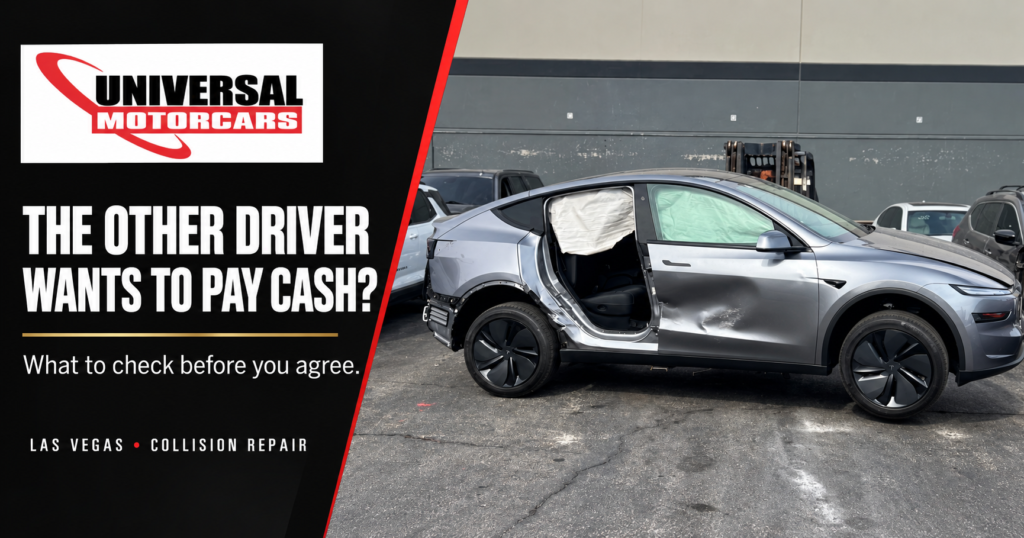
When the other driver says, “I’ll pay for it—just get me an estimate,” it can sound like the easiest way to handle an accident. Get the bumper fixed, avoid the back-and-forth and move on.
But before you agree on a final amount, there is something you need to understand: an estimate written while the car is still assembled may only account for the damage that can be seen. Once damaged parts come off, the repair can become much more involved.
The money offered for a scratched bumper may not be enough to repair what happened behind it.
The damage you can see is only the starting point
From the outside, you might see a crack, a dent or a bumper that no longer sits straight. An estimator can document those things. What they cannot do is see through the bumper cover.
Behind it, the impact may have damaged mounting brackets, an energy absorber, an impact bar or nearby components. A part that looks repairable from the outside may need replacement once the surrounding area is exposed.
That does not mean every small accident turns into a major repair. It means no one should promise that the damage is only cosmetic before the affected areas have been properly assessed.
This is also why two estimates can look very different. One may include visible damage only. Another may include additional operations the vehicle needs. Before comparing the totals, ask what each estimate actually includes—and what has not been inspected yet.
What changes when we take the damaged parts off?
This stage is called teardown or disassembly. We remove the parts needed to inspect the damaged area and understand the repair more fully.
A bumper cover comes off, and now the parts behind it are visible. A damaged panel is removed, and its mounting area can be inspected. What could not be confirmed during the first walk-around can now be photographed and documented.
The estimate can change at that point because the shop has information it did not have before. There may be more parts to replace, more labor involved or additional checks required by the vehicle’s repair procedures.
Sensors can affect the repair, too. For example, Honda restricts repairs to damaged plastic in certain bumper areas used by blind-spot radar on affected models. A small damaged area can therefore require a different repair than its appearance suggests. The exact requirements depend on the vehicle; every bumper repair does not need the same parts or calibration.
The useful question is: “What will it take to repair the accident damage once we know the full extent of it?”
We have a real repair that shows the difference
In our published 2024 Tesla Model Y repair, the first estimate was $7,460.17. The final repair bill was $15,225.92.
As that repair developed, additional components and work were documented through five supplement revisions. The vehicle had damage involving several body areas; it was not simply a scratched bumper.
This was an insurance repair, not a private cash settlement. We share it because it shows how far an early estimate can be from the completed repair—not because your repair will cost the same or your estimate will necessarily double.
Now consider what a fixed cash agreement based only on the first number would leave unresolved: who would pay for the additional work?
“I’ll cover the estimate” needs a second conversation
The other driver may sincerely intend to pay. They may also be expecting a much smaller bill than the vehicle actually needs.
If they agree to the first estimate and the shop later finds additional damage, will they pay the revised amount? What if they disagree with it? What if they stop answering? And who is paying for transportation while your car is being repaired?
Those questions are easier to discuss before the vehicle is disassembled and the repair is underway.
A cash offer based on a visual estimate can leave hidden damage unfunded. Paying privately can still cover a complete repair, but the payment arrangement needs to account for the complete work—not assume that the first number is final.
Before authorizing repairs, tell the shop who intends to pay and ask how additional findings, approvals and payments will be handled. Keep the estimate, photographs, messages and payment records. If someone asks you to sign a final settlement or release, get advice on what you would be giving up before signing it.
What if the cash payment comes from the insurance company?
That is a different situation from the other driver offering a fixed amount to settle privately.
An insurer may send an initial payment based on photographs or an early inspection. That payment does not necessarily mean the repair estimate is final. State Farm, for example, explains that when a shop finds additional claim-related damage, it will review that damage with the shop and pay the additional amount it owes.
When we find additional accident-related damage during an authorized insurance repair, we document it and submit a supplement for review. That is how the estimate can be updated to reflect findings that were not available at the beginning.
A supplement still needs insurer review. Coverage, policy limits and the individual claim matter. Ask your adjuster whether a payment is preliminary and how additional damage will be handled before treating the money as the final repair amount.
And if you already received a check, tell the shop. Bring the estimate that came with it. It helps us understand what has been written, what has been paid and what still needs attention.
What to expect at Universal Motorcars
Start with an in-person visit. We can look at the visible damage, review an estimate you already have and explain what can be assessed at that stage. Tell us how the accident happened and anything you have noticed since—warning messages, rubbing, noises or a change in how the vehicle drives.
Our preliminary visual estimate is free. It is a starting point, not a guarantee that there is no damage underneath.
Teardown for hidden-damage inspection is part of repairs you authorize with Universal, with the vehicle staying for the repair job. We do not take the car apart simply to obtain a higher estimate and then reassemble it for you to drive away without repairs.
For insurance repairs, we photograph additional findings, prepare the supporting information and follow up with the insurer through our collision repair and insurance coordination process. You can also read more about how repair supplements work.
If you are paying privately, we can discuss that too. The repair still needs to follow the vehicle’s condition and applicable procedures. Choosing self-pay does not make damage underneath disappear.
Get the damage assessed before settling on the amount
You do not have to know what is behind the bumper. That is what the inspection and repair-planning process are for. But you should understand what remains unknown before accepting a fixed amount as enough to put your car right.
Keep any required accident reports and insurance notifications moving while you arrange the assessment. A private payment agreement does not replace those reporting obligations.
If you have been offered cash after an accident in Las Vegas, bring your vehicle and any existing estimate to Universal Motorcars for a preliminary visual inspection. We will explain what we can see, what still needs assessment and how the next stage works.
Spring Mountain
5585 Spring Mountain Rd, Las Vegas, NV 89146
702-754-6774
Post Road
3570 W Post Rd, Las Vegas, NV 89118
702-430-1000