
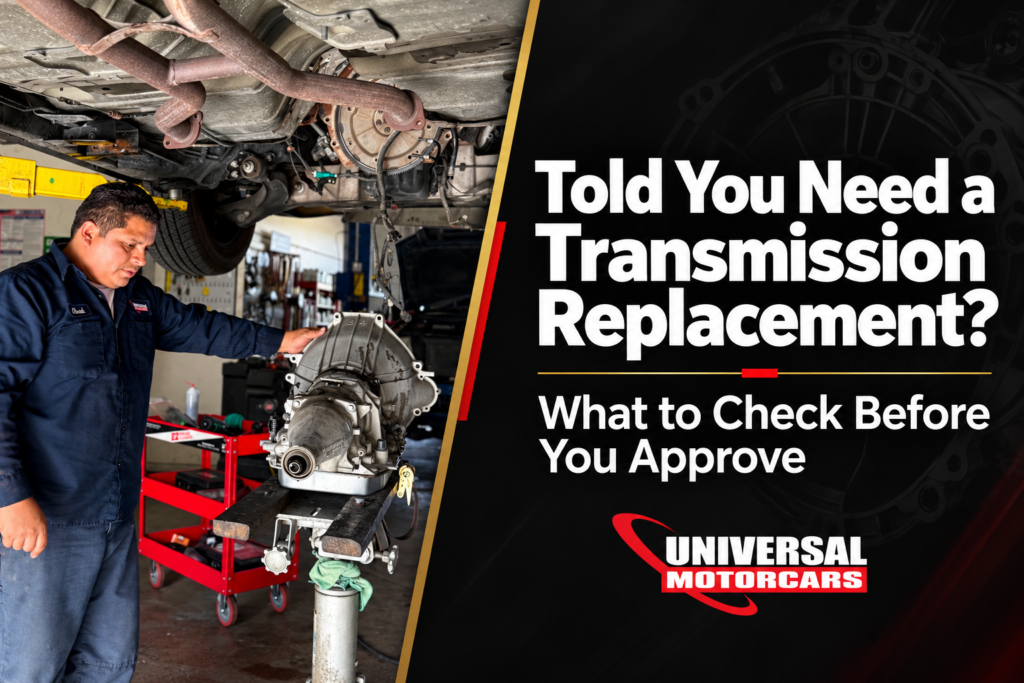
You’ve been told your car needs a transmission, and the estimate is more than you expected. Before saying yes, you want to know whether replacement is necessary, what the price includes, and whether putting that money into the car makes sense.
A transmission replacement recommendation should come with an explanation of the diagnosis, the unit being installed, and the complete proposed work. A shifting complaint alone doesn’t answer those questions.
Here’s how to work through the decision without needing to become a transmission expert.
Start with what the inspection actually found
“It slips” describes a symptom. It doesn’t explain why it happens or identify the repair.
A useful diagnostic explanation connects your complaint with the inspection and test results. Depending on the vehicle, that may involve checking for leaks, checking fluid using the specified procedure, reading fault codes and operating data, and performing further electrical, pressure, or internal checks.
Not every vehicle needs every test. The important point is whether the findings support the recommendation.
Ask: “What did you find that makes replacement the right option for this transmission?”
The answer should explain what has been confirmed, whether a more limited repair is appropriate, and what remains uncertain. If further disassembly is needed, ask what that inspection costs and what happens if you decide not to proceed afterward.
“Replacement” doesn’t necessarily mean a brand-new transmission
Replacement describes the job: removing one transmission and installing another. It doesn’t tell you the condition or source of the replacement unit.
A used transmission comes from another vehicle. Ask about its documented mileage, testing, and coverage.
A remanufactured transmission has been disassembled and restored through the supplier’s remanufacturing process. It can contain both new and reconditioned components; it isn’t automatically an assembly made entirely from new parts.
A rebuild of your existing transmission involves disassembly and repair of that unit. Ask what the proposed rebuild includes and how additional findings could affect the price.
A new transmission is another possibility where available. Don’t assume that “a new transmission for your car” means the estimate actually includes a factory-new unit.
Availability varies. Have the shop identify the exact option being quoted, its supplier, and the written warranty attached to the job.


Compare the completed job, not just the transmission price
Two estimates can look very different because they cover different work.
Look for a written breakdown of the replacement unit, removal and installation, required fluid, related parts, and any programming or setup the vehicle requires. Ask whether taxes, fees, and a refundable deposit for returning the old transmission are included or shown separately.
Warranty details belong in this comparison too. Confirm the time and mileage limits, parts and labor coverage, exclusions, and who handles a claim.
Hypothetical example: One estimate lists a replacement transmission and installation labor but leaves fluid and programming unspecified. Another includes those items and clearly states the warranty. The first estimate may still be competitive, but its lower total doesn’t yet tell you the cost of a completed job.
Ask for the missing details before choosing.
Timing deserves the same clarity. Is the unit available, or still being sourced? Does the expected completion date include delivery, installation, any required setup, and final checks? That matters when you’re arranging rides or paying for a rental.
Is the car worth repairing?
A replacement transmission addresses the transmission problem. It doesn’t renew the rest of the vehicle.
Consider the car’s overall condition, other known repairs, maintenance history, and how long you want to keep it. Include the cost and inconvenience of being without it.
A vehicle you know well may be worth repairing even when the bill is substantial. If it also needs other major work, the combined expense deserves a closer look.
There isn’t one percentage of the car’s value that makes the decision for everyone. Compare the proposed repair and foreseeable work with what it would realistically take to move into another suitable vehicle.
Can you keep driving while you decide?
If the vehicle loses drive, cannot accelerate predictably enough for traffic, or displays a stop warning, stop somewhere safe and arrange professional assistance. Don’t keep pressing the accelerator to force it to move.
Follow the dashboard message and your vehicle’s owner’s manual for a transmission-temperature warning. A phone description cannot confirm that the car is safe to drive.
For more detail, read our guide to transmission slipping symptoms and when to stop driving.
Bring the estimate to Universal Motorcars
Universal Motorcars offers transmission diagnosis and second-opinion evaluations at our Spring Mountain location.
Bring the written estimate, any diagnostic results, and your vehicle’s service history. We can evaluate the concern and discuss the recommended next step, including what may need further investigation.
Call 702-754-6774 to discuss an inspection at 5585 Spring Mountain Rd, Las Vegas, NV 89146. Ask about the inspection scope, diagnostic charges, and scheduling when you call.
You can also review our transmission repair and replacement services before your visit.
Technical references: ZF’s remanufacturing process; Ford owner’s manual example of transmission warning messages. Warning instructions vary by vehicle; follow your own owner’s manual.
Pingback: Automatic Transmission Slipping: Symptoms and Next Steps
Pingback: Explore How Long Does A Rebuilt Transmission Last?