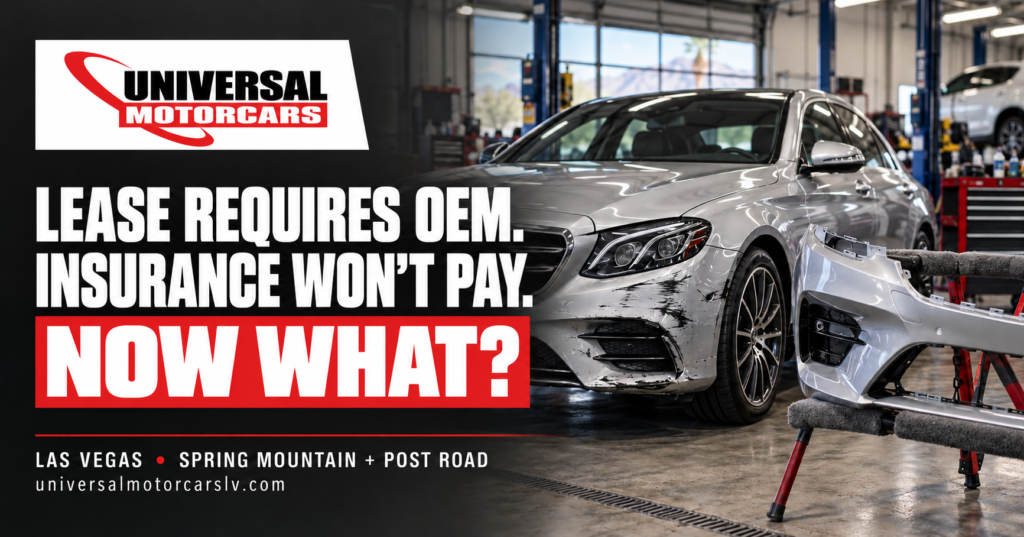
You’ve had an accident, you’ve opened the claim, and now you’re trying to get your leased car repaired. Then the parts question comes up.
Your lease calls for original parts. The insurance estimate includes aftermarket parts. You’re already thinking about the deductible, the rental and how long you’ll be without the car. Now there might be another bill.
Yes, a difference between your lease requirements and your insurance coverage can leave you with an additional cost. But before you agree to pay it, the lease wording, the policy and the actual repair estimate need a closer look.
Sometimes the estimate needs correcting. Sometimes there’s a repair reason to request a different part. And sometimes the policy genuinely leaves a difference that insurance won’t cover. Finding out which situation you’re in is the first step.
“But the leasing company accepted my insurance.”
That’s a reasonable question. You provided the insurance information when you took the car home. Nobody stopped the deal. So why would the repair requirements and the coverage be different?
A lease can require you to carry collision and comprehensive coverage with certain limits and deductibles. Separately, it can set conditions for how the vehicle must be repaired. Meeting the insurance requirements doesn’t necessarily mean your policy pays for every repair condition in the lease.
The lease describes your obligations to the company that owns the car. Your insurance policy describes what your insurer agrees to cover. A parts requirement in the lease does not, by itself, add OEM coverage to the insurance policy.
That’s why “I have full coverage” doesn’t settle this question. Ask for the actual policy language and any endorsements—the documents that add or change coverage.
First, find out what your lease actually requires
Get the signed lease and look for the sections about damage, repairs, replacement parts and vehicle return. If the wording is unclear, ask the leasing company to identify the requirement in writing.
Be specific: does it require new original parts? Does it accept certain used original parts? Are there requirements for the repair facility or approval before work starts?
Those details matter. A used original door is still an OEM part, but it isn’t a new OEM door. If your agreement requires new parts, calling a used part “OEM” doesn’t resolve the issue.
Also check who holds the lease. The dealership where you picked up the car and the company that owns it may be different businesses. You want an answer from the company responsible for the lease, or someone authorized to speak for it.
Aftermarket doesn’t automatically mean poor quality
OEM means original equipment manufacturer. An aftermarket replacement comes from a different manufacturer. A recycled OEM part is an original part removed from another vehicle.
There are well-made aftermarket parts, and there are parts we wouldn’t recommend for a particular repair. The supplier, exact application, fit, vehicle equipment and repair procedure all matter.
For example, CAPA certification includes testing for qualities such as materials, fit and finish. That’s useful information. It doesn’t make the part a manufacturer-branded part or establish that your leasing company accepts it.
We’re comfortable discussing the budget. The question is whether a proposed option works for the vehicle and satisfies the applicable lease requirements. Our guide to OEM, aftermarket and recycled collision parts explains those choices in more detail.
No OEM endorsement? There are still questions worth asking
Not having an OEM endorsement doesn’t automatically mean every part on the estimate must be aftermarket. Progressive’s own explanation says insurers may include OEM parts depending on the vehicle and repairs. It also explains that choosing OEM over an acceptable alternative can leave a cost difference.
Before assuming that difference is yours, work through the following.
Ask what the insurer is actually declining
Is the adjuster declining one specific part? Saying the policy doesn’t guarantee all-new OEM parts? Or using an alternative because that’s what the first estimate priced?
Ask for the relevant policy wording and a written explanation of the disputed item. “We don’t cover OEM” is too broad to tell you what happens with this bumper, headlamp or door.
If you’re claiming against the other driver’s insurer, explain that at the start. That is a liability claim; your own policy’s OEM endorsement isn’t the basis of that insurer’s obligation. The damage, liability, available coverage and applicable rules need to be considered. Your lease requirement alone still shouldn’t be treated as a promise that the other insurer will pay the difference.
Check the part against the actual car
A part description on an estimate is a starting point. The proposed replacement has to suit the vehicle’s equipment and the repair being performed.
Newer vehicles make that conversation more specific. A bumper can involve sensor mounting and required calibration. A structural repair can have particular material and attachment requirements. For example, Tesla’s 2025+ Model Y collision manual calls for Tesla-approved parts and distinguishes those from third-party used or recycled parts.
When there’s a documented reason a proposed part won’t work, the repair request should explain it. Photographs, part information, measurements and the relevant procedure give the adjuster something specific to review.
Compare the actual price difference
Ask whether current OEM supplier pricing can reduce the difference. Ask whether the original damaged part can be repaired properly under the vehicle’s procedures. Those are possibilities to investigate, not discounts or repair options anyone can promise before checking.
Then compare the complete work. A lower parts price may come with different preparation or installation needs. The useful number is the agreed difference for the finished repair.
A simple example: an estimate allows $600 for a replacement part, while the agreed OEM alternative is $900. If the insurer maintains its $600 allowance, the remaining parts difference is $300. That is separate from any deductible. These are illustrative figures; taxes and any difference in associated work would need to be included in a real quote.
How we handle that conversation at Universal
Bring us the insurance estimate and tell us the vehicle is leased before authorizing repairs. If the leasing company has sent you repair or parts instructions, bring those too.
At Universal Motorcars, we review the damage, explain the proposed work and handle repair-related discussions with the insurer directly. You shouldn’t have to explain a damaged mounting point to an adjuster yourself.
Our repair-related supplement process takes place with the vehicle at our shop, appropriate authorization in place and findings documented during inspection, disassembly or repair planning. We submit additional repair needs with supporting evidence as appropriate. Our insurance supplement guide walks through that process.
Documenting a repair need helps the insurer review it. It doesn’t create coverage that the policy doesn’t provide, and it doesn’t guarantee approval.
If a cost may become your responsibility, we explain the reason and amount before asking you to authorize it. That includes an unresolved parts difference, a deductible or work outside the covered accident repairs. You should have a chance to understand the decision while there’s still a decision to make.
Allow time for these questions to be resolved. A revised estimate, a replacement part or a response from the leasing company can affect the schedule. If your lease return date is close, tell us early.
Can you choose the body shop?
In Nevada, NRS 690B.016 gives insured drivers and claimants the right to choose a licensed body shop. An insurer cannot require one particular licensed shop over another. The law also does not require the insurer to pay more than the reasonable rate required under the policy.
For a leased vehicle, check the leasing company’s repair conditions as well. Permission from the insurer and acceptance under the lease are separate questions.
The public guidance shows why the details are worth checking:
- BMW Financial Services recommends original BMW parts in its return guidance and warns about additional charges from unapproved parts.
- Mercedes-Benz Financial Services says damage must be reported to the insurer and MBFS, recommends dealer repairs, and explains that substandard work can lead to lease-end charges in its leasing FAQs.
- Tesla’s U.S. return guide includes a condition that previous repairs were facilitated through a Tesla Service Center or authorized service provider. It directs customers with a third-party lessor to that company’s instructions. Check the guidance for your lease before choosing the repair route.
Even the badge doesn’t give the whole answer: Chase’s Tesla return instructions separately call for repairs at a licensed facility and repair receipts. Tell us who holds the lease so the relevant requirements can be checked before work starts.
What if you don’t agree to the aftermarket parts?
Say so before they’re installed and explain the concern.
Nevada’s body-shop rules require written identification, warranty-source information and owner consent before installing the aftermarket body parts covered by those rules. Used body parts also require written identification and consent. These rules have specific definitions for body parts; they aren’t a blanket rule for every component on a car.
There is also an insurer disclosure requirement when an estimate uses the non-OEM body parts defined in that regulation.
Those protections help you understand and authorize the repair. Refusing an alternative doesn’t, by itself, make insurance fund a more expensive part. The payment question still needs to be resolved, along with any authorization required under the lease.
Keep the paperwork. Lease return can be months away.
Save the final repair invoice, parts descriptions, approved supplements and any written instructions or acceptance from the leasing company. Keep relevant scan, alignment or calibration records provided with the repair.
Check how the insurance payment will be issued, too. Mercedes-Benz Financial Services, for example, describes checks payable jointly to the customer and Mercedes-Benz Vehicle Trust, with endorsement requirements. Sorting that out early can help prevent a payment delay when the car is ready.
As return time approaches, use the lessor’s pre-inspection process where available. If you’re dealing with a small cosmetic mark, compare the inspection’s assessed charge with the repair quote before spending money. For accident repairs, a pre-inspection also gives you time to address a concern before handing over the vehicle.
It’s better to have the invoice and written answers ready than to try to reconstruct the repair months later.
A few other questions that come up
Will aftermarket parts void my entire factory warranty?
No, not simply because they’re aftermarket. The FTC explains that aftermarket or recycled parts do not automatically cancel warranty coverage. Coverage for damage caused by a defective part or improper installation can be denied when the required connection is established. Warranty rights and lease-return requirements are separate issues.
Does GAP coverage pay the OEM difference?
GAP addresses a different situation: a qualifying total loss where the vehicle’s value and the remaining loan or lease balance leave a shortfall. It isn’t an OEM parts upgrade for a repairable vehicle. Check the particular GAP coverage or waiver terms.
What should I ask my insurance agent before the next accident?
Show the agent your lease’s repair requirements and ask whether the proposed policy meets them, including parts coverage. Ask about an OEM or new-original-parts endorsement, its limits and availability for your vehicle in Nevada. Some insurers offer that option; others don’t. For example, Farmers lists New Original Parts coverage, subject to availability and policy terms. Any new coverage needs a confirmed effective date; don’t assume a change will pay for damage that has already happened.
Bring the estimate and the lease instructions. We’ll help you work through the repair.
You don’t need to arrive knowing the difference between every parts abbreviation. Bring the car’s information, the insurance estimate, claim details and the relevant lease pages or written instructions.
For collision repairs at Universal Motorcars in Las Vegas, call the location that works for you:
- Spring Mountain — 5585 Spring Mountain Rd, Las Vegas, NV 89146 · 702-754-6774
- Post Road — 3570 W Post Rd, Las Vegas, NV 89118 · 702-430-1000
We’ll help you understand the proposed repair, what needs checking with the insurer or leasing company, and any costs that need to be agreed before the work goes ahead.