You want your car back looking right, driving right and properly repaired. You also want someone to answer the phone, explain what’s happening and deal with the insurance questions without making every one of them your problem.
That’s a reasonable expectation. When you’re choosing an auto body shop in Las Vegas, look closely at the finished work, the customer reviews and how the team explains its repair process. A good choice should give you confidence in both the repair and the people looking after it.
At Universal Motorcars, we’re a family-owned business with collision teams at Spring Mountain and Post Road. Here are the questions we’d want answered before leaving our own car—and how we handle them here.
1. What will the finished repair actually look like?
You know your car. You’ll notice if a bumper sits differently, a door doesn’t close the way it used to or the repaired panel catches your eye for the wrong reason.
Paint matching, panel fit and careful reassembly matter to us. We want you to walk up to your car and feel good about what you see. Our repair gallery gives you a look at actual vehicles our team has worked on. Ask about the repairs behind those photos, too.
The finish is only part of the work. Attachments, wiring, corrosion protection and the affected systems need attention as well. We follow the applicable manufacturer repair information for the vehicle and the damage.
For example, Tesla’s 2020–2024 Model Y body-repair instructions call for corrosion protection after structural repairs and replacement of factory seam sealer removed or damaged during repair. You may never see that work after the panels go back on. It still belongs in the repair.
2. What do customers say once they have their cars back?
Reviews are worth reading beyond the stars. Look for the details: how the car turned out, whether someone explained the changes and how the shop handled a concern.
We’re proud of what customers say about both our workmanship and the way we take care of them. These are excerpts from their Google reviews:
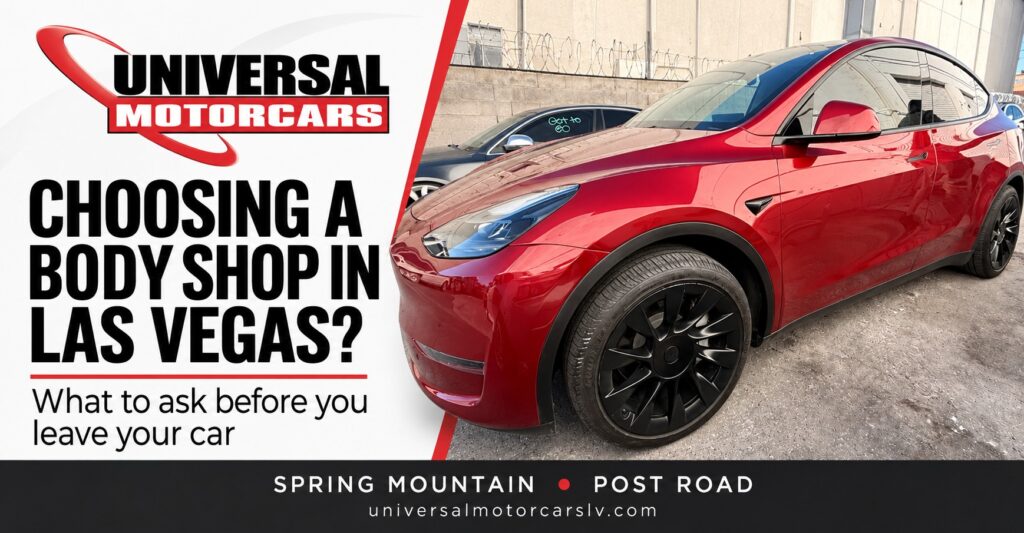
“The red paint color match is incredible”
— Elena DWC, describing her Tesla Model Y repair at Universal Motorcars – Post Road, October 19, 2026.
“They handled the communication with the insurance company directly, including all the supplement discussions”
— Zhaoyu W., Universal Motorcars – Spring Mountain, May 19, 2026.
Read the full reviews and others on both profiles. You can also check our BBB business profile. We want you to have something more useful than our word for it.
3. Who’s going to deal with my insurance company?
You shouldn’t have to spend your lunch break explaining a damaged reinforcement or a repair procedure to an adjuster. That’s our side of the job.
When we’re repairing your vehicle, our team handles the repair-related calls, emails, supplements and adjuster follow-up directly. If inspection or disassembly reveals additional accident damage, we document it and submit the additional work with photographs, measurements, part information or manufacturer procedures as appropriate.
The insurer’s first estimate doesn’t decide everything your vehicle needs. It reflects what was identified and allowed at that stage. A necessary repair operation doesn’t become unnecessary because it was left off that estimate.
If an item is questioned, we follow up on the reason and the evidence. We explain why the work is needed and work to resolve the difference. We don’t simply send you back to argue about repair details you’ve never had to deal with before.
Finding hidden damage doesn’t mean we immediately hand you an unexpected bill. A supplement is a documented request, and coverage and approval still matter. Deductibles, policy limits, unrelated damage and work you request outside the claim can affect what you owe. We discuss any potential customer responsibility before asking you to authorize it.
Our insurance-supplement guide explains the process in more detail.
4. Do you work on vehicles like mine?
A family SUV, a Maybach and a Tesla can each need a different repair approach. The model, materials, equipment and damage matter more than a general promise that a shop can “fix anything.”
Universal works on everyday cars, European and luxury vehicles, Teslas and other EVs. Tell us the year, make and model, and we’ll discuss the repair and the appropriate location.
Universal has I-CAR Gold Class recognition. Our Spring Mountain location also participates in factory-certified collision programs for select manufacturers. Ask which program applies to your vehicle and where the work will be performed.
We’re also proud of our 2025 Best of Las Vegas Gold award for Collision Center. Training, recognition and real repair examples are useful things to check together.
5. How do you decide what gets repaired and what gets replaced?
It’s reasonable to care about cost. It’s also reasonable to ask why a part needs replacing when the damage doesn’t look that bad.
We look at the damage, the material and the vehicle’s repair requirements. If a panel can be repaired appropriately, keeping it may make sense. A damaged attachment point or a manufacturer restriction can change that answer. We explain the reason.
The same care goes into choosing OEM, aftermarket or recycled parts. OEM means the vehicle manufacturer’s original-equipment part. An aftermarket part isn’t automatically a poor choice, but being listed on an approved estimate doesn’t establish that a particular part will fit properly.
We’ve had cases where an approved aftermarket lamp didn’t sit or fit correctly once installed. We documented the problem and requested an OEM replacement through a supplement when justified. We check the part, the installation and the surrounding damage so the request addresses the actual cause. Approval still has to be resolved with the insurer.
Whether you’re using insurance or paying yourself, your budget should be a comfortable conversation. You deserve to understand the proposed repair and cost before choosing.
6. Can you order the parts before I drop off my car?
We understand the thinking: get everything here first, then spend less time without the car.
At Universal, collision parts aren’t ordered until the vehicle is in our shop and teardown has happened. Teardown means removing the affected parts so we can inspect what was hidden, as part of the work you authorize.
A simple example: a photo may show a damaged bumper cover. Once it comes off, we may also find a broken retainer or damaged reinforcement. An order based only on the photograph wouldn’t account for those pieces.
That inspection helps us build a more complete parts order. Further needs can still come up during repairs, and we’ll explain those changes.
7. How long will it take—and what could change that?
There’s a difference between a part being ordered and the right part arriving undamaged. There’s also a difference between finishing the paint and having the vehicle ready for pickup.
A part can arrive damaged. Further inspection can uncover another issue. An insurer may request more information or a reinspection. Required measurements, diagnostic work and calibration also have to be completed.
We discuss the expected steps and update you when something changes the schedule. You should know what we’re waiting for and what needs to happen next.
Tell us early if your rental coverage is running out. We can coordinate with the insurer and rental provider, although an extension depends on the claim, coverage and availability. Our collision-repair timing guide explains the stages behind the pickup date.
8. What am I agreeing to when I bring the car in?
Start by telling us what happened and what you’ve noticed. That includes the obvious dent and anything else that changed: an off-center steering wheel, a door that catches, a warning message or a new noise.
We investigate those concerns rather than assuming every symptom has the same cause. You don’t need to know the correct technical name for something to ask us about it.
Our preliminary visual estimate is free. We explain what we can identify at that stage and what needs a closer look. Diagnostic testing or disassembly is a separate step, with the work and any charges explained before authorization.
If the vehicle is at a tow yard, we help coordinate towing and authorized impound pickup. Before arranging a move, we work through the destination, release requirements, authorization and charges that need to be addressed. Permission to move the vehicle doesn’t automatically authorize us to dismantle or repair it.
We can also help coordinate rental arrangements. You don’t have to have every detail sorted out before calling.
9. What happens at pickup—and if I have a concern afterward?
At pickup, you should understand what was repaired, what changed from the first estimate and any care instructions that apply.
Our final checks follow the work performed: panel fit, attachment, paint and affected functions, along with the scans, alignment, calibration or other checks the vehicle requires. If something concerns you—a gap, a color difference, a noise—point it out. We want to look at it with you.
Universal backs its paint and workmanship with a lifetime warranty. Ask us for the written terms that apply to your repair and keep them with your invoice. Parts and other types of work can have separate coverage.
If you notice a concern after pickup, contact the team that handled the repair. We’ll inspect it and explain the next step, including whether it relates to the repair or needs a separate diagnosis.
Talk with the team that will be looking after your car
You can choose your licensed body shop in Nevada, even when an insurer recommends somewhere else. Nevada’s shop-choice law protects that choice; it doesn’t automatically settle every question about coverage or repair costs.
Both Universal locations handle passenger-vehicle auto body and collision repairs, including luxury vehicles and Teslas.
- Spring Mountain: 5585 Spring Mountain Rd, Las Vegas, NV 89146. 702-754-6774.
- Post Road: 3570 W Post Rd, Las Vegas, NV 89118. 702-430-1000.
Call with your vehicle information, what happened and any claim details you already have. Bring the vehicle and existing estimate when it can be driven safely, or tell us where it is so we can discuss towing. We’ll look at the damage, explain what we know and help you understand what comes next.