
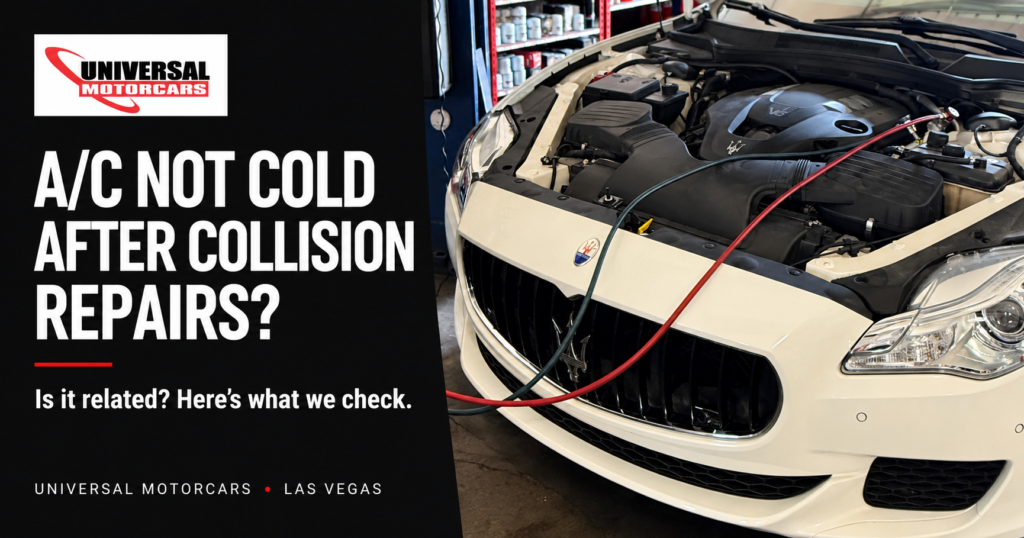
You get your car back from the body shop, turn on the A/C, and warm air comes out. Of course you’re going to ask: “Did something get missed?”
It could be connected to the accident or the repair, but the timing alone doesn’t prove it. Hidden damage, a problem with something that was worked on, and an unrelated failure can all leave you with the same complaint. We need to find the cause before deciding who should pay for it.
At Universal Motorcars, we want you to bring that concern to us. Tell us what the A/C is doing and when it started. Then we can compare it with where the car was hit, what was repaired, and what the tests show.
“It worked before the accident. What happened?”
Tell us when you last remember the A/C working properly. Did it stop cooling immediately after the impact? Was it cold when you collected the vehicle and warm a week later? Does it work on the road but turn warm at a stop?
Those details help. They don’t identify the failed part on their own.
A damaged refrigerant line in the impact area gives us a physical connection to investigate. A loose connection at a part that was removed during repairs raises a different question. An internal fault in a component away from the damaged area may turn out to be unrelated.
The question is: What failed, and what evidence connects that failure to the accident or the repair? Sometimes the answer is clear. Sometimes more testing is needed. A fault code or a low refrigerant reading can help find the problem, but neither automatically tells us when it began.
A slow leak can leave the A/C cooling for a while before enough refrigerant is lost for you to notice. So a delayed symptom doesn’t settle the question either. It needs to be compared with the physical findings and repair history.
Can radiator damage affect the A/C?
Yes, it can—but the radiator and the A/C condenser aren’t the same part.
On a typical gasoline or diesel vehicle, the radiator helps remove heat from the engine’s coolant. The A/C condenser releases heat from the refrigerant used to cool the cabin. They often sit close together near the front of the vehicle, which is why people understandably mix them up. DENSO explains these separate jobs in its guidance on engine radiators and A/C condensers.
Here’s how that difference plays out after an impact.
The impact damages the condenser
If the condenser is punctured and loses refrigerant, the A/C can stop cooling even though the engine temperature stays normal. A normal temperature gauge doesn’t clear the A/C system of damage.
That also means a condenser replacement on an estimate doesn’t necessarily mean the engine radiator needs replacement. Each part needs its own assessment.
The radiator is damaged, but the condenser isn’t leaking
A leaking radiator loses engine coolant, not A/C refrigerant. Replacing that radiator doesn’t automatically mean the vehicle needs an A/C recharge. Refrigerant service may still be necessary if the vehicle’s repair procedure requires opening the A/C circuit.
There can also be an indirect connection. If radiator damage causes the engine to overheat, some vehicles reduce or switch off A/C operation to protect the engine. Ford documents this behavior in its cooling-system guidance. In that situation, warm air doesn’t necessarily mean the compressor or condenser has failed.
The impact affects the parts around both systems
The radiator and condenser need airflow. Depending on the vehicle, they share a fan arrangement and nearby supports, shrouds or air guides. Damage that interferes with that airflow can affect cooling without creating a refrigerant leak.
That’s why an A/C complaint after front-end repairs may call for checking the fan, wiring, mounting and airflow—not just connecting a recharge machine. Tell us if it cools while you’re moving and gets warm in traffic; that pattern helps guide testing.
If the engine-temperature warning comes on, the gauge enters the hot range, or you see steam, stop safely and switch off the engine. Don’t open a hot cooling-system cap. An overheating or coolant-loss problem needs attention beyond the cabin A/C complaint.
What if the accident only damaged the rear bumper or pickup bed?
Here’s a simple example—not a customer case. A pickup comes in with damage limited to its rear bed. Later, its front-mounted A/C compressor develops an internal fault. If inspection finds no damage to the A/C system, related wiring or other systems that connects the two, the rear-bed accident alone doesn’t explain that compressor failure.
That doesn’t make the warm air any less frustrating. It means we need to diagnose it as its own problem instead of assuming the collision claim covers it. Repairing a damaged bed doesn’t reset the age or condition of every mechanical part on the truck.
There’s a limit to that explanation, though: not every vehicle keeps all of its A/C equipment up front. Some SUVs have refrigerant lines and an additional evaporator in the rear. If the impact reaches those parts, there may be a connection worth checking.
Real vehicle examples: A/C equipment isn’t always in the same place
These manufacturer-documented examples show why the year, model and equipment matter:
| Vehicle example | Where relevant A/C equipment is located | Why it matters after an impact |
|---|---|---|
| 2016–2020 Honda Civic sedan and coupe | The condenser is at the front; Honda’s inspection procedure removes the front bumper to reach it. | Front damage can put the condenser in the area that needs inspection. A leak still needs a cause identified. |
| 2016–2017 Ford Explorer | Ford documents rear evaporator lines entering the body and accessed behind the driver-side cargo-area trim. | There are A/C lines at the rear to consider if damage reaches that area. |
| 2021 Chevrolet Tahoe/Suburban, GMC Yukon and Cadillac Escalade | The rear heating and A/C case, including an evaporator, sits behind trim at the right rear wheel-well area. | Rear-quarter damage can be close to actual A/C equipment, including on a luxury SUV such as the Escalade. |
| Porsche Taycan, original launch design documented in 2019 | Porsche identifies a coolant radiator at the front left and an A/C condenser at the front right, within a linked thermal-management system. | A front-corner impact needs to be assessed against the actual layout. The radiator and condenser aren’t interchangeable. |
Examples are limited to the documented designs, not every model year. Manufacturer references: Honda Civic, Ford Explorer, Chevrolet/GMC SUVs, Cadillac Escalade and Porsche Taycan.
An evaporator is the part that absorbs heat from the air being cooled for the cabin. A rear evaporator is different from simply having vents for rear passengers. The shop needs to check the vehicle’s actual equipment before drawing a conclusion from where those vents are.
Teslas and newer vehicles need their own repair information
A familiar-looking symptom doesn’t mean a familiar repair applies.
For example, Tesla’s 2024-and-newer Model 3 service manual describes refrigerant circuits serving the cabin and a high-voltage battery heat exchanger. Its A/C collision guidance also distinguishes damaged systems that have leaked refrigerant from those that haven’t. The required work differs.
That doesn’t mean every Tesla climate-control complaint is accident damage. It means the diagnosis and repair plan need to match that vehicle. The same care applies to luxury SUVs with rear A/C and vehicles with heat-pump systems. An explanation based only on “the unit is in the front” leaves too much out.
Our Tesla A/C and climate-control service information explains how to arrange the appropriate inspection.
Could it be a separate A/C problem?
A worn component, an electrical fault or a manufacturing issue can cause trouble without an accident. That doesn’t automatically mean the owner neglected the car.
Honda provides a useful example. Its Civic condenser bulletin distinguishes leaks caused by a manufacturing condition and resulting corrosion from leaks caused by foreign-object damage. The symptom can be the same—lost refrigerant and poor cooling—but the cause and potential payment route are different.
If a manufacturer program may apply, eligibility needs to be checked by VIN, vehicle history and the program’s terms. Finding a bulletin online isn’t confirmation that a particular repair is covered.
Maintenance can still matter. A restricted cabin filter can reduce airflow, for instance. But that finding doesn’t explain a punctured condenser, and it shouldn’t be used to dismiss a separate collision-related concern.
What should happen when you bring the vehicle back?
Start with the shop that completed the repairs and explain what you’re noticing. If Universal repaired your vehicle, contact the team that handled your repair so we can review the records and arrange the next step.
We need to compare the current problem with the original damage, the work performed and any recorded test results. Was the refrigerant system opened? Were A/C parts replaced? Was a fan or its wiring removed to complete the repair? Those are useful questions, especially after front-end work.
Depending on the findings, diagnosis may include checking vent temperature and airflow, testing for leaks, checking fan and electrical operation, and inspecting components in or near the repair area. The vehicle’s service information guides the tests.
A small leak or an intermittent fault can take more effort to locate than something visibly broken. If the symptom only happens after a long drive or while sitting in traffic, tell us. A short check in the service bay may not reproduce it.
And if the system is low on refrigerant, adding more isn’t the whole answer. The EPA explains that a recharge doesn’t permanently fix a leak. Restoring cooling can be part of the work, but the cause still needs attention.
Ask what the initial diagnosis includes and what it will cost before authorizing it. Our broader guide to A/C repairs in Las Vegas covers common cooling complaints and service options.
Who pays if the A/C needs another repair?
The findings help determine the next step.
If we find additional accident damage: with the vehicle at our shop and appropriate authorization in place, we document the findings and handle the repair-related discussion with the insurer. Photographs, test results and relevant repair procedures can support an insurance supplement, which is a request to review additional repair work. It isn’t automatic approval or payment.
If the concern points to work we performed: we review that connection and the applicable repair or parts terms. It deserves investigation, not an automatic explanation that the car is simply getting older.
If the fault is unrelated: it may need a separate estimate. Depending on the vehicle and failure, a manufacturer warranty or service contract may be worth checking. Otherwise, the repair may be the owner’s responsibility.
As Progressive’s mechanical-damage guidance explains, accident-related mechanical damage and an ordinary breakdown are treated differently. The actual claim and policy determine coverage. Deductibles, limits and disputed items can also affect payment.
We discuss potential customer responsibility before asking you to authorize additional work. If testing shows the fault is unrelated, we’ll explain the findings and the repair options. We can support an accident claim with documented damage; “it happened after the bodywork” on its own isn’t enough.
Bring the concern—and the details that help us check it
You don’t need to diagnose the car before calling. Have these details ready:
- The year, make and model, and where the vehicle was hit.
- Your repair invoice or claim number, plus any recent A/C service records.
- When you first noticed the problem and when you last remember it cooling normally.
- Whether the air is warm, the airflow is weak, or the issue affects only certain vents.
- Whether it changes at idle or on the road, and any warning messages.
If another shop has already tested it, bring the written findings and photographs. A specific finding helps much more than a note that says only “A/C doesn’t work.”
Universal Motorcars handles collision and auto body repairs in Las Vegas at both locations.
General passenger-vehicle A/C diagnosis is at 5585 Spring Mountain Rd, Las Vegas, NV 89146, 702-754-6774.
For a concern following repairs at 3570 W Post Rd, Las Vegas, NV 89118, call that team at 702-430-1000; we’ll help coordinate the appropriate next step. Tesla service is available at both locations, with scheduling confirmed for the vehicle and work needed.
Call with your repair information and tell us what the A/C is doing. We’ll explain what needs to be checked and how to move forward.