
No. Airbags going off do not automatically total a car. The decision depends on what the full repair involves, the vehicle’s pre-accident value and the rules that apply to the claim.
That can be hard to believe when you’re looking through the window at airbags hanging inside the car. The damage suddenly feels much bigger than a dented door or broken bumper. You want to know whether you’re getting your car back—or need to start looking for another one.
There’s a real example worth looking at before you assume the worst.
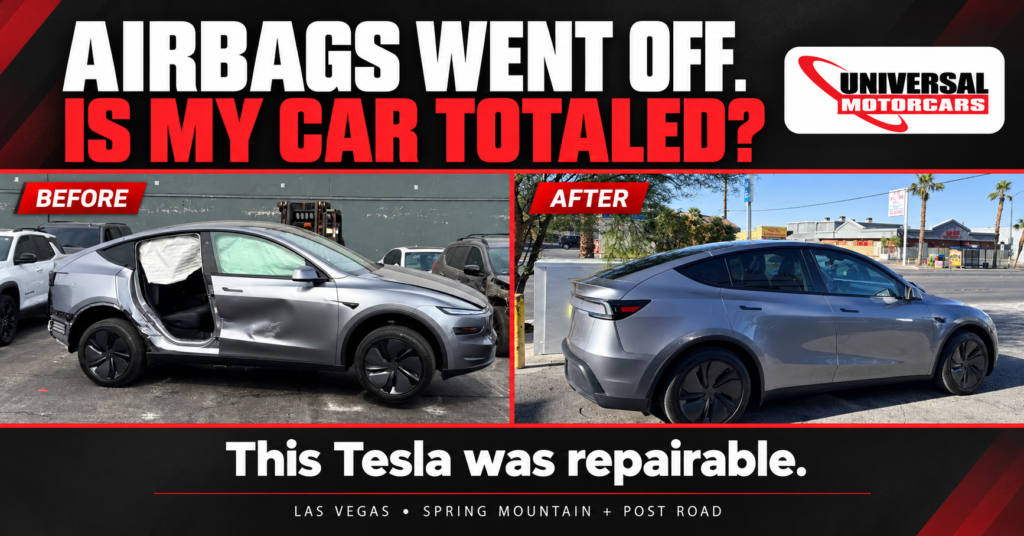
This Tesla’s airbags deployed. It was still repairable.
The Tesla in these Universal Motorcars before-and-after photographs had airbag deployment and was repairable. In the before image, you can see side damage and a deployed curtain airbag inside the cabin. The after image shows the repaired exterior.

Airbag deployment was part of this car’s repair needs. It wasn’t the end of the story.
For another car, even one with similar-looking damage, the answer could be different. Its value may be lower, the impact may have damaged different components, or the manufacturer may require a different repair. A photograph can help start the conversation. It cannot settle all of those questions.
If your airbags have deployed, arrange a tow. NHTSA advises replacing deployed airbags before driving the vehicle again. An engine that starts—or a Tesla that still powers on—doesn’t tell you whether the car can protect you in another crash.
What actually makes a car a total loss?
Two questions need answering: what would it take to repair the vehicle properly, and how does that cost compare with what the vehicle was worth before the accident?
A car can have a valid repair procedure and still become a total loss because of the cost. An older, dependable car may be worth a great deal to you because it’s paid off and gets you everywhere you need to go. Its market value may leave much less room for an expensive collision repair.
A newer vehicle may have more value to work with. But a higher value doesn’t guarantee a repair, either. Parts, labor and the extent of the damage still matter. The insurer evaluates the claim; the shop documents the repair the car actually needs.
Nevada’s 65% rule needs a little explanation
Nevada’s law generally defines a total-loss vehicle using repair costs of 65% or more of its fair market value immediately before the damage. For this calculation, painting, towing, and electronic-component replacement performed to manufacturer specifications are excluded. There are also specific exceptions, including limited repairs to certain older vehicles.
So dividing the grand total on an estimate by an online car value may give you the wrong answer. And you shouldn’t assume that an entire airbag-system repair falls under the electronic-component exclusion.
Ask the adjuster to show you the vehicle valuation and which repair costs were included in the calculation. “The airbags went off” isn’t a complete explanation.
Why the repair can involve much more than new airbags
The airbag you can see is one part of the restraint system. The system also involves seat belts, tensioning devices, sensors, wiring and a control module. On an estimate, you may see it called SRS, short for supplemental restraint system.
A seat-belt pretensioner tightens the belt during a crash. Once it has fired, the manufacturer may require replacement of the belt assembly and related parts. A belt can look intact and still need attention.
Depending on the vehicle and what deployed, the repair can also involve the steering wheel or column, a seat assembly, trim, or other interior components. Some parts need inspection; others have a replacement requirement triggered by deployment. Those are different reasons for putting an item on the estimate.
That’s why an online price for one airbag tells you very little about the complete repair.
What newer vehicles actually require: two manufacturer examples
For the 2025-and-newer Tesla Model Y, Tesla’s collision procedures call for replacing the steering wheel assembly when the driver’s front airbag deploys. Deployment of the driver’s front or knee airbag also calls for the steering column assembly and steering column control module. A deployed front-seat side airbag calls for replacement of the seat assembly containing it.
Honda’s 2026 CR-V owner guidance says an inflated airbag requires replacement of the control unit and related parts. Activated automatic seat-belt tensioners also require replacement. It calls for certain restraint-system inspections after a moderate-to-severe collision even when the airbags did not inflate.
These examples explain why a technician can recommend replacing a part that doesn’t look broken. The repair plan starts with the vehicle identification number, its equipment and what deployed. A different model or model year may call for different work.
The same care matters with luxury vehicles. A familiar badge or an expensive interior doesn’t tell us which components can stay. We need the exact model, equipment and deployment information before putting together a dependable estimate.
Why the first estimate may not answer the question
A photo estimate might show a damaged door and deployed airbag. It may not establish the condition of the seat mounts, belt anchors, wiring or structure behind the damaged panels. It may also be missing operations required by the manufacturer.
At Universal Motorcars, we review what’s already been written and explain what needs checking. With the vehicle at the shop and the appropriate inspection or disassembly authorized, we document the findings and prepare the repair plan.
If additional accident-related work is needed, we send the insurer an itemized supplement with supporting information such as photographs, measurements and repair procedures. Our team handles those repair discussions directly. You shouldn’t have to explain a steering-column replacement requirement to an adjuster yourself.
That additional work can change the repair-versus-total-loss decision. It doesn’t automatically mean someone made a mistake, and it doesn’t mean we simply hand you the difference as a surprise bill. We work through the repair scope and payment with the insurer and discuss any proposed customer responsibility before you authorize that work.
Our guide to insurance supplements and additional repair findings explains that process in more detail.
How long before you know?
Sometimes the damage makes the likely outcome clear early. Other vehicles need a closer inspection, parts pricing and an insurer review before anyone can give you a useful answer.
If the vehicle will be repaired, timing also depends on the required parts and work. A needed restraint component can be unavailable. A part can arrive damaged. Another finding can require more documentation. A completion date given before those questions are resolved can change.
Ask what’s holding up the next step: the inspection, the repair estimate, an insurance decision or a particular part. That’s more useful than being told only that the car is “still being worked on.”
Can the car be safe after an airbag repair?
Airbag deployment alone does not make a vehicle permanently unsafe. What matters is whether its damage can be repaired properly and whether the required work is completed and checked.
A repaired exterior doesn’t show you everything that happened underneath. Ask which restraint components were replaced, which were inspected, and what procedures and final checks applied to your vehicle.
A diagnostic scan can help identify electronic faults. It doesn’t inspect a seat-belt mounting point or measure the body structure. Clearing a warning light doesn’t replace a deployed airbag or a fired pretensioner. Camera and driver-assistance calibrations, where required, are separate work from restoring the airbag system.
Parts sourcing matters, too. In its September 3, 2026 update, NHTSA warned about dangerous replacement inflators marked DTN60DB. It also explains that a clean VIN recall search cannot rule out those aftermarket inflators. Ask where replacement restraint parts come from and keep the repair records.
What if insurance does decide to total it?
Ask for the written valuation and settlement breakdown. Check that the year, trim, mileage and equipment match your car, and ask about any condition adjustments or deductions. Nevada’s claim-settlement rules address comparable-vehicle valuations and require the basis for the settlement to be disclosed in writing.
If you still have a loan, ask how the settlement will be paid and whether you have applicable GAP or loan-payoff coverage. The balance you owe and the vehicle’s value can be different.
Before agreeing to keep the vehicle, understand the title and rebuilding requirements as well as the repair bill. Nevada DMV’s salvage guidance explains that a vehicle with a salvage title cannot be registered and driven until the required rebuilding and inspections are completed. Salvage vehicles five model years old or newer need DMV restoration authorization before rebuilding. A nonrepairable designation is different: those vehicles cannot be restored for road use.
Also confirm the rental return date, who is arranging vehicle pickup, and how any authorized shop or storage charges will be handled. Those details need attention even while you’re reviewing the settlement.
A few questions that come up next
Only one airbag went off. Does that make it a smaller repair?
It may mean fewer deployed airbags to replace, but it doesn’t establish the full cost. The impact damage and the components linked to that particular deployment still need checking.
Can my car be totaled if no airbags deployed?
Yes. Repair costs can still make it a total loss. Airbags respond to crash conditions and system design; they don’t calculate the vehicle’s value. No deployment is not proof that the damage is minor.
Will insurance pay to replace the airbags?
Replacement can be part of a covered collision repair. Payment depends on the claim, the available coverage and whether the vehicle is being repaired or settled as a total loss. Confirm any deductible and unresolved items before approving work.
Not sure whether your car is repairable? Call either Universal Motorcars location.
Tell us the vehicle’s year and model, which airbags deployed, where the car is now, and whether you already have an insurance estimate or claim number. We’ll explain the next step for a collision damage assessment and help coordinate towing when needed. Please call before arranging a drop-off.
- Spring Mountain: 5585 Spring Mountain Rd, Las Vegas, NV 89146. Call 702-754-6774.
- Post Road: 3570 W Post Rd, Las Vegas, NV 89118. Call 702-430-1000.
You don’t need to decide the car’s future from the airbags hanging in the window. Start with finding out what this vehicle actually needs.