
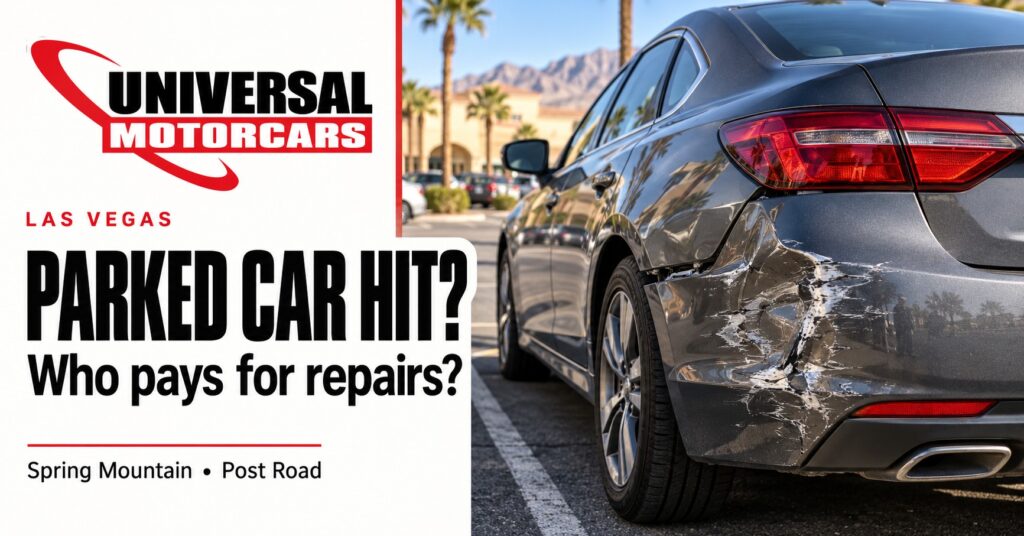
You come back to your car and find a damaged bumper, a dented door, or a scrape that definitely wasn’t there when you parked. There’s no note, and the other driver is gone.
If the driver is identified, their insurance may pay for the damage. If they aren’t, your own collision coverage may help, usually after your deductible. Without applicable coverage, you may need to pay for repairs yourself. Being parked doesn’t automatically make the damage a comprehensive claim.
You can start documenting the damage, reporting what happened, and getting the vehicle assessed while those insurance questions are being sorted out. Here’s where to start.
Take photos before the details disappear
If it’s safe, photograph the car before moving it. Get a few pictures showing the entire vehicle and where it was parked, then move closer to capture the damage.
Look beyond the most obvious dent. Photograph nearby scrapes, broken lights, a bumper that’s separated from the body, or anything else that looks different. Save the original files.
It also helps to record:
- The address, parking level, or section where the car was parked.
- When you parked and when you discovered the damage.
- Any note, license plate information, or witness contact details.
- The name of the business or security office you spoke with.
If you’re at a casino, shopping center, apartment complex, or workplace, ask security whether cameras cover that area and whether relevant footage can be preserved. They may have a process for releasing it to police or an insurer. You don’t have to know exactly when the impact happened—give them the most accurate time window you can.
If the damage affects a tire or wheel, a door won’t latch, something is hanging loose, or you notice a fluid leak, get advice before driving. A car that starts may still need to be towed.
Reporting a parked-car hit-and-run in Las Vegas
A report from property security can be helpful, but it isn’t the same as a police report.
For an incident in LVMPD’s jurisdiction, call 702-828-3111 for non-emergency reporting guidance. Explain that someone hit your parked vehicle and left, and mention whether you have a plate number, witness, or video.
One detail that can save you time: LVMPD’s standard online citizen-report form excludes traffic collisions and hit-and-runs. Don’t select a different incident type just to get through the form. Ask which reporting process applies to your situation.
If it happened in Henderson or North Las Vegas, contact the police agency responsible for that location. The address where the damage occurred matters more than the city listed on your mailing address.
Keep the report or incident number with your photos and claim information. Tell the insurer what you know, and be clear about what you don’t know. “I found the damage when I returned to the car” is more useful than guessing how fast the other driver was going or exactly when it happened.
Who pays depends on the coverage available
If the other driver is identified
You can contact that driver’s insurer and make a property-damage claim. The insurer will review what happened, whether its policy applies, and the damage being claimed.
Having a license plate or video helps establish what happened, but it doesn’t automatically mean the insurer has accepted responsibility or approved the repair.
If you also have collision coverage on your own policy, ask your insurer whether using it would help you move forward while the other claim is investigated. Your deductible may apply.
If the driver can’t be found
Collision coverage is generally the part of your own policy that can pay for damage caused by another vehicle hitting your car, even when your car was parked. The payment depends on the policy, covered repair cost, and deductible.
Comprehensive coverage usually addresses different losses, such as theft, vandalism, fire, or weather damage. A vehicle striking your parked car is generally a collision loss; the fact that you weren’t driving doesn’t change that distinction. The Nevada Division of Insurance explains these coverage differences.
And if your policy lists uninsured motorist coverage, ask exactly what it covers. Coverage for injuries is different from coverage for damage to your vehicle. Don’t assume that having “uninsured motorist” on the policy means the body repair is covered.
A useful question for your adjuster is:
“My car was parked, and the driver who hit it left. Which coverage on my policy could pay for the vehicle damage, and what deductible would apply?”
If you only carry liability coverage
Your own liability coverage generally pays for injury or property damage you cause to others. It doesn’t ordinarily pay to repair your own car after an unidentified driver hits it.
If there’s no applicable coverage and no responsible party available to pay, a self-pay repair may be the practical option. Getting the damage assessed will help you understand what that involves before you decide.
Why would I owe a deductible when I didn’t cause the damage?
This is understandably frustrating. You didn’t hit anyone, but you may still be asked to pay part of the repair.
A collision deductible is the portion of a covered claim you agreed to pay under your policy. It isn’t a determination that you caused the accident.
For a simple example, suppose the covered repair is $2,400 and your collision deductible is $1,000. Assuming the repair is approved and no other adjustments apply, the insurer’s portion would be $1,400, and your portion would be $1,000. That’s an illustration, not a repair quote.
If your insurer later recovers money from the responsible party, you may recover some or all of your deductible. That recovery process is called subrogation. Ask how your insurer handles it; reimbursement isn’t guaranteed.
If the damage appears minor and your deductible is high, tell the shop you’re comparing an insurance claim with paying yourself. An estimate can help you make that comparison. Just remember that a preliminary visual estimate may change if an authorized inspection reveals additional damage.
Report the incident promptly according to your policy’s requirements rather than assuming you should wait until you have a final repair price.
Will a not-at-fault claim raise my insurance?
Nevada has a protection that matters here: state law prohibits an insurer from increasing your renewal premium because of a claim where you weren’t at fault. It also protects certain inquiries about coverage, including hypothetical and informational questions.
That doesn’t mean your overall premium can never change for another reason. Ask your insurer how it has classified the incident, and request an explanation if your renewal price changes.
You shouldn’t have to guess whether asking about your coverage will be treated the same as causing an accident.
Get the damage checked before deciding how to repair it
A scraped bumper and a bumper that has been pushed out of position can require very different work.
Photos are useful, but they don’t show everything. An in-person assessment helps identify visible damage, affected parts, and whether further inspection is needed. On vehicles with sensors near the damaged area, the repair plan also needs to account for the vehicle’s equipment and applicable manufacturer procedures.
That doesn’t mean every parking-lot impact requires an expensive repair. It means the decision should come from what’s damaged, not just how small the mark looks.
Our guide to bumper repair versus replacement in Las Vegas explains some of the differences.
If damaged parts need to be removed to understand the repair fully, that should be discussed and authorized first. Permission to prepare a visual estimate isn’t the same as permission to dismantle the vehicle or begin repairs.
What if the insurance estimate doesn’t cover everything?
An insurer’s first estimate may be based on photographs or the damage visible during an initial inspection. Additional accident-related damage can become apparent as the repair is planned.
At Universal Motorcars, our repair-related supplement process happens with the vehicle at our shop, appropriate authorization in place, and the findings documented. We submit the additional repair needs with supporting information and communicate directly with the insurer.
A supplement is a request for additional repair work and payment. It isn’t automatic approval.
Finding more damage also doesn’t mean we simply hand you an unexpected bill. We work through the repair scope and payment questions with the insurer and explain any potential customer responsibility before you authorize it. Your deductible, unrelated damage, and work you request outside the claim are separate considerations.
You can read more about how insurance supplements work during collision repairs.
Can I have the car repaired before the claim is settled?
Before authorizing repairs, ask the insurer what inspection and documentation it needs. You don’t want damaged parts discarded or repairs completed before the insurer has had the opportunity it requires to review the loss.
That doesn’t mean you have to sit and do nothing. You can gather evidence, report the claim, choose a shop, and discuss an assessment while the insurance review continues.
If you decide to proceed as a self-pay customer, make sure you understand the agreed work and payment arrangement. Paying first doesn’t guarantee that an insurer will reimburse you later.
If the car can’t be driven, our guide to a vehicle towed after a Las Vegas accident explains how recovery and transportation can be addressed while insurance investigates.
How Universal Motorcars can help
You don’t need to arrive with every insurance question answered.
Bring the vehicle, your photos, any existing estimate, and your claim information if you’ve opened a claim. If you have a police report number or an adjuster’s contact details, bring those too.
We can start with a preliminary visual estimate, explain what we can identify at that stage, and discuss whether further inspection is needed. For insurance repairs, our team documents the repair findings and coordinates with the insurer. For self-pay repairs, we explain the proposed work and costs so you can make an informed decision.
Both Universal Motorcars locations handle collision and auto body repairs in Las Vegas:
- Spring Mountain: 5585 Spring Mountain Rd, Las Vegas, NV 89146 — 702-754-6774
- Post Road: 3570 W Post Rd, Las Vegas, NV 89118 — 702-430-1000
If someone hit your parked car and left, call either location with your vehicle information and what you know so far. We’ll explain how to bring it in, what to bring with you, and the next step toward understanding the repair.
Featured image: AI-generated illustration.