Your car has been towed after an accident. The yard wants payment, and the other driver’s insurance company says it’s still investigating. Meanwhile, you need to know where the car is and what you’re supposed to do with it.
You can start locating the vehicle, checking its release requirements, and planning its next move before the insurer accepts responsibility for the accident. The important thing is to confirm who can release it, where it can go, and how the charges will be handled before arranging another tow.
Once the immediate safety needs have been handled, here’s how to work through those decisions in the Las Vegas Valley.
Find the vehicle and the company holding it
Start with the paperwork or information the responding officer gave you. You’re looking for the towing company’s name, the vehicle’s destination, and the police incident number. If you arranged the tow yourself, check the dispatch confirmation or call the company you used.
For a police-arranged tow, the agency that handled the crash matters:
- LVMPD: Metro’s vehicle-location guidance directs drivers to AutoReturn. Have your plate number or VIN ready. If you need help, LVMPD lists 702-828-3111 for non-emergency assistance.
- North Las Vegas: The city’s Locate My Vehicle page also directs drivers to AutoReturn for police impounds, private-property tows, and repossessions.
- Henderson: Henderson’s AutoReturn instructions specifically describe private-property impounds and repossessions. For an accident tow, confirm the destination with the responding officer or Henderson Police at 702-267-5000.
- Another agency: If Nevada State Police/Highway Patrol or Boulder City Police handled the crash, check with that agency. An empty search result doesn’t tell you that the car wasn’t towed.
Once you find the listing, call the yard. Confirm the exact address where the vehicle is being held, its identifying information, and the hours when it can actually be released.
Ask what is needed to release it
Before making the trip—or paying for a tow truck to meet you there—ask whether the vehicle is available for release.
A police or evidence hold is different from an unpaid bill. If there’s a hold, ask which agency placed it and whom to contact about clearance. Under Nevada’s towing rules, the yard follows the releasing agency’s instructions. A repair shop or insurance adjuster can’t simply override that hold.
Next, ask which documents the yard will accept to establish ownership and identity. Have your photo ID and registration or other ownership paperwork available, but confirm the requirements for your situation. If those documents are inside the car, ask how to retrieve them.
Someone else may be able to handle pickup for you, including a repair shop, with the appropriate authorization. Ask the yard what form it requires, who must sign it, and whether any additional verification is needed. Don’t assume handing someone your keys gives them permission to collect the vehicle.
Get the bill—and ask what happens to it tomorrow
Ask for an itemized statement showing the original tow, storage dates and rate, and any other charges. Then ask for the amount needed to release the vehicle on the planned pickup date, the accepted payment methods, and when the next storage charge would apply.
There isn’t one daily storage price you can safely assume applies to every yard and every tow. For nonconsensual towing, Nevada requires charges to follow the operator’s approved tariff, meaning its authorized schedule of rates and rules. You can check the operator through the Nevada Transportation Authority’s tariff directory.
If an item doesn’t make sense, ask the yard to explain it in writing. The NTA accepts towing complaints; keep the invoice, notices, and communications if you need its help.
A pending insurance claim doesn’t, by itself, stop permitted storage charges. Send the bill and any pickup or lien notice to the adjuster promptly. If you receive a notice about a proposed sale of the vehicle, address the notice directly rather than assuming the open claim puts it on hold.
Talk to the insurer and the repair shop while the investigation continues
When the other driver’s insurer says it hasn’t accepted liability, it means the company hasn’t agreed that it is responsible for paying your claim. With this kind of claim against another driver’s insurance, the company may still be reviewing fault, coverage, or information about the accident. Having a claim number isn’t the same as having towing or storage approved.
You can still ask for a specific plan. Tell the adjuster where the vehicle is, what the yard currently wants, and what additional storage would cost. Ask whether the insurer will arrange a transfer, pay the yard directly, or consider reimbursement—and request written confirmation of any approved amounts or dates.
At the same time, speak with the repair shop you’re considering. Confirm whether it can receive your vehicle, help coordinate release, and explain the arrangements before you commit. Give the insurer the proposed destination and ask how it wants to inspect the damage before disassembly or repairs.
Should I leave it there until the other driver’s insurance accepts fault?
Don’t treat waiting as the only option. Once the vehicle is releasable, compare the cost and practicality of leaving it where it is with moving it to a suitable destination. Include the second tow and any charges at the receiving facility in that comparison.
There are situations where an immediate move isn’t possible: a police hold, missing release paperwork, a payment problem, or nowhere suitable to take the car. Tell the adjuster exactly what is preventing pickup and keep a record of the steps you’re taking. That gives everyone something concrete to work on.
Can I use my own insurance?
If you carry collision coverage, ask your insurer about opening a claim under your own policy while the other company investigates. The Nevada Division of Insurance explains that collision coverage applies to collision damage regardless of fault, subject to the policy and deductible.
Your insurer may later seek repayment from the responsible party or their insurer. That process is called subrogation, and it may also recover some or all of your deductible; deductible recovery isn’t guaranteed. Having liability coverage alone does not provide collision coverage for your own car.
Will insurance pay for towing and storage?
Those expenses may be part of a covered accident claim, but get the answer for your claim before relying on it. Ask which tow, storage dates, and amounts the insurer will pay, whether it has set a cutoff, and whether you must pay first. Payment can depend on coverage, responsibility for the accident, policy limits, and whether the charges are considered reasonable. A roadside-assistance benefit can have different terms from accident-related towing.
If the insurer disputes a charge, ask it to identify the item and explain its position in writing. Send that response to the yard or shop so the actual disagreement can be addressed.
What if I can’t afford the release charges?
Say so early. “Move the car” isn’t a complete solution when you don’t have the money to release it or a place where it can stay.
Ask the insurer whether direct payment or an insurer-arranged transfer is available under the claim. If you have your own collision coverage, ask that insurer about the available route, too. Ask the yard whether any payment arrangement or applicable hardship reduction is available.
You can also ask the repair shop what arrangements it can offer before transportation is booked. If anyone offers to advance a payment, have them explain in writing who is responsible for repaying it if coverage is denied, the vehicle is totaled, or you decide to repair elsewhere. An advance means someone is paying now; it doesn’t necessarily mean the charge has been waived.
Agree on the destination and what you’re authorizing
Nevada protects your choice of a licensed body shop for repairs. That choice does not automatically settle who pays every charge. A temporary storage or inspection destination is also a separate decision from choosing who will repair the car.
Depending on the situation, the next destination might be your chosen repair shop, a facility arranged with the insurer, or another secure location where the damaged vehicle can legally and safely be kept. Confirm that the destination will accept it and what charges may apply while it waits.
Keep these three decisions clear when you read the paperwork:
- Moving the vehicle: permission to release it to the identified person or towing company and take it to the agreed location.
- Inspecting or dismantling it: permission for specified diagnostic or disassembly work, with the associated terms explained.
- Repairing it: approval of the repair work and payment arrangements.
These permissions may appear on the same form, so ask what your signature covers. A tow to a shop does not, by itself, mean repairs should begin. Before authorizing disassembly, ask about any agreed inspection, disassembly, reassembly, or other charges if repairs don’t go ahead.
Also tell the tow coordinator about missing wheels, locked wheels, lost keys, or other loading concerns. Identify the vehicle accurately, especially if it’s a Tesla, another EV, an RV, or a commercial truck, so appropriate transportation can be arranged.
What if it might be a total loss?
Tell the adjuster before arranging another move. Ask whether an inspection is needed where the car is now or whether the insurer wants to arrange a different destination. This can help avoid an unnecessary tow to a shop that won’t be carrying out repairs.
Confirm who will handle the current bill, the next tow, and storage at the new location. Permission to move a vehicle for evaluation is different from accepting a settlement or transferring ownership. Read the documents and ask what each one authorizes.
What happens when the vehicle reaches Universal Motorcars?
Our team helps coordinate towing and authorized impound pickup. You provide the vehicle and claim information, the yard’s details, and the required owner authorization. We review the release and transportation arrangements with you and confirm which location should receive the vehicle before pickup is booked.
Once it arrives, we review the damage and the next authorized step. A preliminary visual estimate describes what can be identified at that stage. Further inspection or removal of damaged parts may be needed to understand the full repair.
During authorized inspection, disassembly, and repair planning, we document accident-related findings and communicate with the insurer about the repair needs. If additional work is identified, our insurance-supplement process provides the supporting information for review. The estimate documents the damage; the insurer’s coverage and payment decisions are separate.
We explain the proposed work and any potential customer responsibility before you authorize it. Moving the car here does not automatically approve coverage, start repairs, or eliminate every subsequent charge. The purpose is to establish a clear plan for your vehicle and the work you want us to perform.
Both Universal locations handle passenger-vehicle collision and body repairs, including Tesla accident damage. Post Road also handles RV, motorhome, commercial-vehicle, and semi-truck body and collision work. We’ll confirm the appropriate destination for your vehicle and the requested service.
Have these details ready when you call
- The vehicle’s year, make, model, plate number or VIN, and whether you have the keys.
- The towing company, storage address, and any known police hold or release requirement.
- The current itemized bill and any notices from the yard or insurer.
- Your insurer, claim number, adjuster’s contact information, and what has been approved so far.
- Any accident photos or estimate you already have.
You don’t need every answer before calling. Call Universal Motorcars with the vehicle’s location, basic information, and claim details, and we’ll help explain the next steps for an authorized pickup and collision assessment.
Spring Mountain
5585 Spring Mountain Rd, Las Vegas, NV 89146
702-754-6774
Post Road
3570 W Post Rd, Las Vegas, NV 89118
702-430-1000
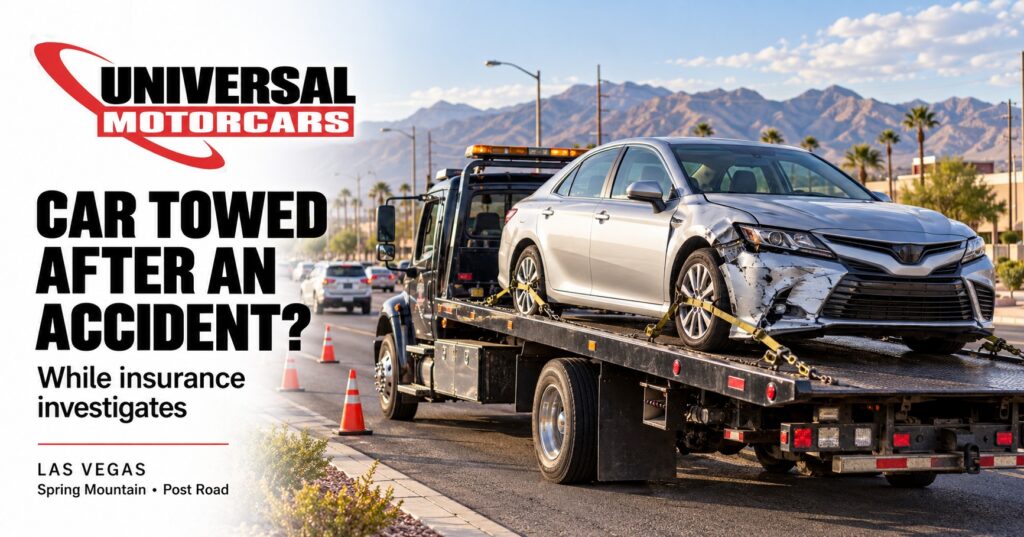
Featured image: AI-generated illustration.
Pingback: Where to Take Your Car After an Accident in Las Vegas