
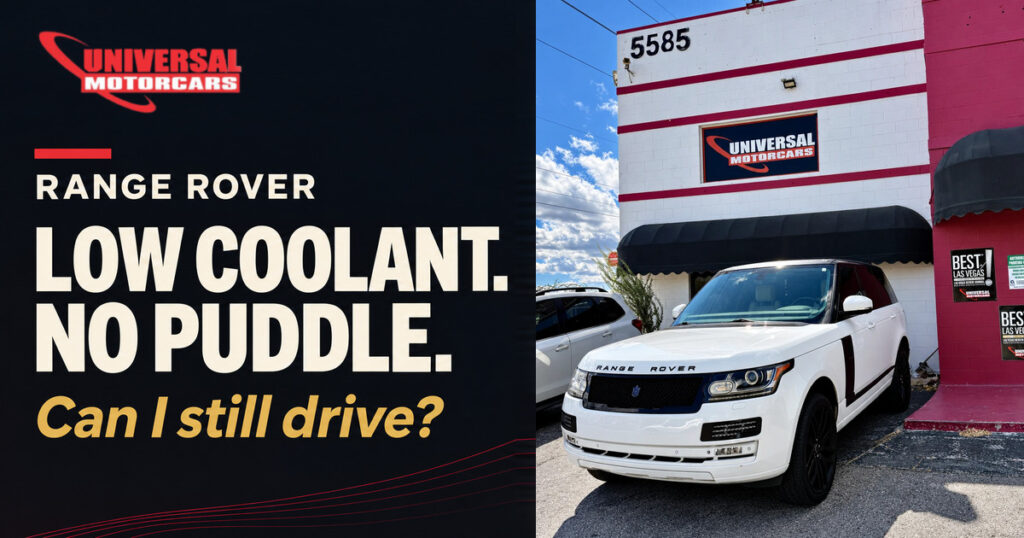
Your Range Rover says “Low Coolant,” but the spot where you parked overnight is dry. Can you drive it to the shop? If you see steam, the temperature gauge is in the red, or the dash tells you to stop, don’t try to make it the last few miles. Pull over as soon as it’s safe, follow the instructions on the dash and arrange roadside help. Never open a hot coolant cap.
If the low-coolant message is the only warning and the car feels normal, park it and let the engine cool completely before checking the level. If the reservoir is empty, you’ve suddenly lost a lot of coolant, or it won’t hold what you add, leave the engine off and arrange a tow.
First, was the coolant actually low?
Look at the cold-fill marks on the side of the engine coolant reservoir. The Land Rover handbook for your model and year shows you which tank to check. If the level is a little low, follow the handbook’s top-up instructions and use the coolant it specifies. If it’s already in range, leave it alone. If you can’t verify the level, or the message stays on or comes back, call before driving farther.
This matters on a plug-in hybrid. The 2024 Range Rover has separate instructions for engine coolant and high-voltage battery coolant. Only a trained technician should top up the battery coolant. If you’re looking at two reservoirs and aren’t sure which one the message refers to, leave both caps on.
Where can coolant go without leaving a puddle?
A hose connection can seep when the engine is hot and the cooling system is under pressure, then stay dry all night. Coolant can dry on a hot part or collect on the panel underneath the engine. The first sign you see might be the message on the dash.
If you spilled a little coolant the last time you filled it, tell us. On certain Range Rover engines, Land Rover tells technicians to dry the outside of the reservoir before pressure-testing the system. Yesterday’s spill can make a perfectly good tank look like it’s leaking. During a pressure test, the technician puts the system under controlled pressure and watches for fresh coolant. A bead forming at a hose joint tells a different story from a stain around the cap.
Sometimes the pressure drops and nothing leaks where we can see it. On some engines, a cooler can leak internally. At that point in a cooling-system inspection, we’d explain what needs testing next. A pressure drop alone wouldn’t justify selling you a water pump or a head-gasket job.
What if the tank is full when the warning comes on?
Was it full before anyone topped it up? A tank that’s full because you added coolant yesterday tells us something different from one that’s stayed at the same cold mark all week.
Land Rover documented an intermittent warning with the coolant level confirmed correct on some newer-generation Range Rovers (starting with the 2022 model year) and Range Rover Sports (starting with 2023). Its checks include the level sensor, its connector and the wiring. A new sensor won’t fix a damaged wire. If the warning comes and goes, a photo of the exact message, taken while parked, gives us a useful place to start.
Before you pay for a repair, check the VIN
Land Rover service campaign D061 covers certain 2023 and 2024 Range Rovers, Range Rover Sports and Defenders with the 3.0-liter Ingenium gasoline inline-six. Small rubber seals on the coolant lines to and from the turbocharger can leak. If you’ve been quoted for that repair, ask a Land Rover retailer to check your vehicle identification number (VIN). If the campaign is open for your vehicle, a JLR retailer or authorized repairer will replace those seals at no charge. Already paid for that work? Keep your invoice and ask about reimbursement.
If you’ve been handed an older bulletin about low coolant with no visible leak, check the number. Land Rover withdrew its earlier JLRTB02127 bulletin in May 2026 and directed technicians to its current diagnostic instructions and any open service campaigns. If a quote calls for a new reservoir, ask what points to the tank on your Rover.
If the warning comes back after a repair
Bring the earlier invoice, even if another shop did the work. If the message came back the morning after a hose or pump replacement, we’d want to check the connections that were disturbed and whether air was properly removed when the system was refilled. If the cold level held for months and just started dropping again, tell us that, too.
If you already have an estimate, a fair question is: “Did you see this part leak, or is it the next part you need to test?” You should know which one you’re being asked to pay for.
For Range Rover mechanical repairs in Las Vegas, call Universal Motorcars at 702-754-6774. Our mechanical team is at 5585 Spring Mountain Rd, Las Vegas, NV 89146. Tell us the model year and what the dash says. We’ll help you decide whether to arrange a tow and explain the diagnostic charge before testing.