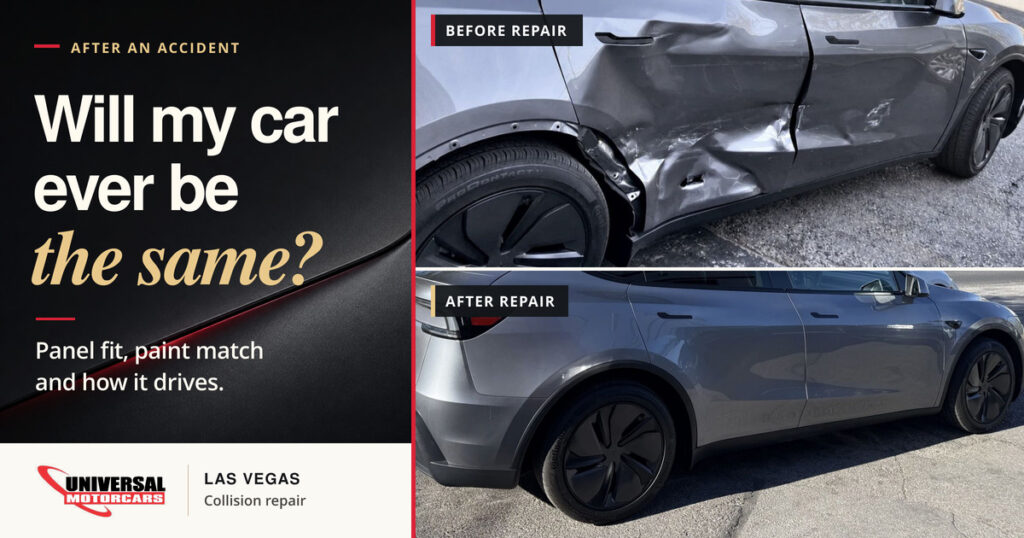
If your driver’s door used to close with one hand, you shouldn’t have to learn to slam it. Yes, a repairable car can look and drive the way it did before an accident. Whether that’s realistic for your car depends on what took the hit and what the carmaker allows the shop to do about it. A photo of a dented fender can’t tell you all that.
Before you leave your keys, ask the person writing the estimate: “When it’s back together, how will you know the repair is right?” A door, a wheel and a camera each call for a different answer.
A door that latches isn’t always a door that fits
Take a sideswipe as an example. Standing behind the car, you might see a nice, even line along both doors. Now open the repaired door and close it as you normally would. Does it shut on the first try, or does it lift a little just as the latch catches? You’ve learned something in five seconds that you couldn’t see in a photo.
The latch catches on a metal loop called a striker. In Tesla’s front-door alignment procedure for the 2020–2024 Model Y, the technician removes that loop to see where the door hangs on its own. First the door has to sit right. Then the striker goes back on so the door closes easily. Forcing the latch to pull a crooked door into place puts extra wear on the hinges and latch.
You don’t need to know how to adjust a door to tell us yours takes a second shove. If it scrapes or hangs up, show the shop. If it won’t stay latched, don’t drive it home.
Will the new paint match the rest of the car?
Look at a metallic blue fender straight on, then take a few steps and look down the side. The color can look different from that angle. A paint code narrows things down, but several shades can share one code. That’s why a painter may spray a test card and compare it with your car in daylight or under a color-matching light.
Sometimes the best result comes from blending the color into the next panel so you don’t see a sharp change where the fender meets the door. If a panel looks darker to you at pickup, ask us to walk outside and look at it together. Tell us where you’re standing when you see the difference.
What if the car looks straight but drives differently?
A steering wheel that sits crooked while the car tracks straight is one concern. Having to steer against a pull to stay in your lane is another. Mention which one you noticed and whether it started with the accident. That detail is more useful than asking for an alignment and hoping it fixes whatever changed.
A wheel hit calls for a look at the wheel, tire and nearby steering and suspension parts. An alignment adjusts wheel angles. It can’t straighten a bent control arm, the part that helps hold the wheel in position. If the shop does an alignment, ask to see the before-and-after readings. We explain the difference in our guide to a car that pulls after an accident.
If the impact reached the body structure, ask a different question: “What tells you the mounting points are back where they belong?” That’s where measurements against factory dimensions matter. An alignment printout tells you about the wheels. It doesn’t tell you how a damaged structural part was repaired or whether the carmaker allows that method.
Does a clear dashboard mean the safety systems are ready?
A scan reads faults the car’s computers have recorded. It doesn’t aim a camera. Calibration gives the system a reference for where that camera is looking in relation to the car. It can be necessary even when there’s no warning light.
For example, GM calls for scans during a collision estimate and again after repairs. Whether a camera also needs calibration depends on the vehicle and the work. If a camera came off your car, ask which procedure applied and, if calibration was required, whether it finished successfully. Leave testing features like automatic emergency braking to the shop.
What if you only notice something on the way home?
A whistle near the top of a door can be impossible to hear in a parked car. Call the shop and describe which side you heard it on, roughly what speed you were going and whether it was there before the accident. You don’t need to prove the seal is bad or make another freeway trip to reproduce the noise. If the steering or brakes feel unsafe, pull over somewhere safe and arrange a tow.
At Universal, we’ll compare what you’ve noticed with the area that was hit and the work we did. If the concern traces back to our repair, we’ll explain what needs correcting. If we find a different cause, we’ll show you what points to it.
Our limited lifetime warranty covers our collision paint and body workmanship for as long as you own the vehicle we repaired for you. Keep the written terms with your final bill so you know what’s covered and what’s excluded.
Will it be worth the same when you sell it?
A car can drive beautifully and still have a reported accident in its history. A future buyer may offer less because of that history even when the repair was done properly. Keep the itemized final bill and any repair photos, measurements or calibration results available to you. They let you show what was fixed if a buyer asks. Our guide to diminished value in Nevada looks at that separate question.
Bring the estimate. Tell us what feels different.
If the estimate says “replace fender” but your bigger worry is how the steering feels, tell us both things when you call. Both Universal Motorcars collision repair locations in Las Vegas offer a free preliminary visual estimate. We can look at the car with you, show you what’s visible and explain what we’d need your permission to check underneath.
Spring Mountain · 5585 Spring Mountain Rd, Las Vegas, NV 89146 · 702-754-6774
Post Road · 3570 W Post Rd, Las Vegas, NV 89118 · 702-430-1000