
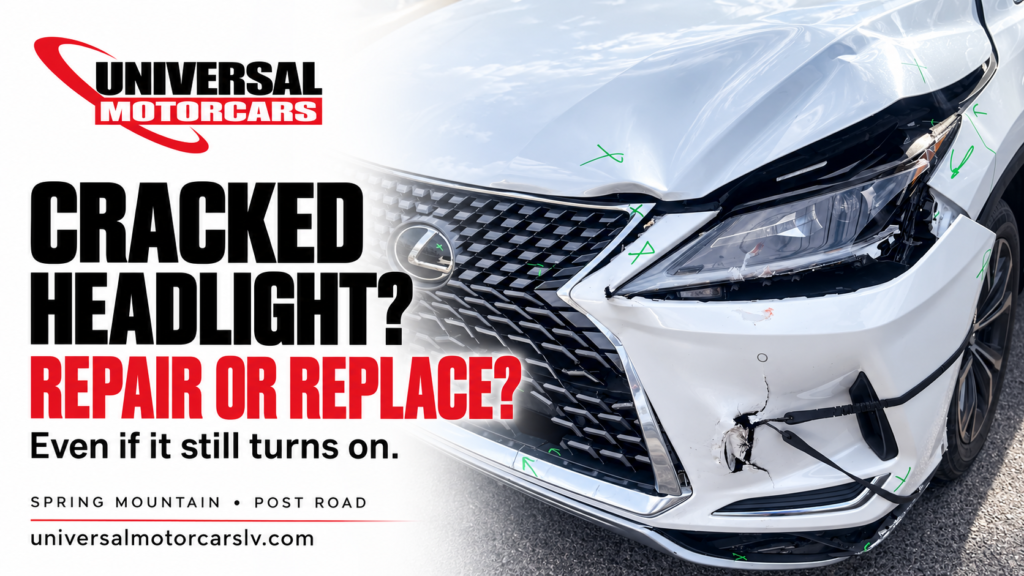
The headlight has a crack, but you switch it on and it still lights up. Then the repair estimate includes a replacement assembly, and you’re wondering whether that’s really necessary.
A headlight can still turn on and need repair or replacement after an accident. The light working tells us something useful. It doesn’t tell us whether the housing is damaged, the mounting points are intact or the beam is aimed correctly. On the other hand, a scuff or a damaged bracket doesn’t automatically mean you need a complete new headlight.
Before you spend the money—or decide to leave it alone—we need to see what actually broke and what can be repaired on your particular vehicle.
“It still works” is a starting point
When you look at a headlight, most of what you see is the clear outer lens. Behind it are the housing, mounting points, wiring and lighting components. A hit near the bumper or fender can damage areas that aren’t visible with everything still assembled.
That’s why a headlight inspection looks beyond whether it turns on:
- The lens and housing: Is it a surface mark, a crack through the material or damage around a seal?
- The mounting points: Is the lamp securely held in the right position, or is a bracket or attachment broken?
- The light itself: Do the low beams, high beams, turn signals and other fitted functions work correctly?
- The aim and surrounding fit: Does the lamp point where it should, and does it sit correctly against the bumper, hood and fender?
A lamp can illuminate while sitting crooked. It can also look fairly normal from the front with damage hiding behind it. Those are reasons to inspect it, not reasons to replace every part around it.
Our collision-repair inspection considers the surrounding accident damage too. A headlight that won’t line up may be telling us something about the panel or support it attaches to.
Can you replace just the clear cover or a broken bracket?
Sometimes there’s a smaller repair available. Sometimes there isn’t.
We check the manufacturer’s repair information and parts listing for the exact vehicle. Some components are separately serviceable. Others come as part of a larger assembly. Finding a replacement cover online doesn’t, by itself, tell you whether the manufacturer provides a suitable lens-only repair for your lamp.
Tesla gives a good example of why the details matter. Its 2020–2024 Model Y procedure provides for replacing a headlight bracket separately. It also says to replace the assembly if that bracket isn’t available as a standalone serviceable part.
So “the bracket broke” isn’t enough information to price the repair. We need to know which bracket, whether the lamp itself survived and what the repair procedure allows.
If a suitable smaller repair is available, it belongs in the conversation. If the assembly needs replacing, you should be able to understand why.
Why a newer headlight can cost so much
It’s fair to question a large headlight charge. You may be remembering a bulb replacement that took minutes. The estimate may be for an entire lighting assembly, with electronics and functions that the old bulb never had.
Even two vehicles with the same model name can have different lighting equipment. Mercedes-Benz, for example, lists standard LED headlights and optional DIGITAL LIGHT on the EQE SUV. The optional system uses a light module with LEDs, micromirrors and electronic control. A similar-looking lamp isn’t necessarily the correct replacement.
Access and setup can add work too. Tesla’s left-headlight replacement procedure for the 2020–2024 Model Y includes releasing one side of the front bumper cover, reinstalling vehicle software and adjusting the headlights. That’s a specific procedure for that vehicle, not a rule that every headlight replacement needs the same steps.
For a newer car, luxury vehicle or EV, the useful question is: “Does this estimate include the correct lamp and everything needed to install and set it up?” The VIN, equipment and repair information help answer that.
Insurance approved an aftermarket headlight. What if it doesn’t fit or look right?
This can happen, including when the claim is through the at-fault driver’s insurance company.
The first estimate may allow an aftermarket headlight—a new replacement made by a company other than the vehicle manufacturer. That description alone doesn’t tell us the part is unsuitable. For example, CAPA’s lighting certification standard includes checks for dimensions, appearance, illumination and vehicle test fit. Certification also isn’t the same as approval from your vehicle’s manufacturer.
At Universal Motorcars, we’ve had cases where an insurance-approved replacement lamp didn’t sit or look right once it was fitted. When there’s a genuine fit or appearance problem, we can document it and submit a supplement requesting an OEM replacement.
OEM means a part made by or for the vehicle manufacturer. A supplement is the additional repair request and supporting evidence we send to the insurer when the existing estimate needs to change.
The important part is showing what’s wrong. A lamp sitting too far out against the fender, mounting points that don’t line up, or an incorrect internal finish gives us something specific to explain. Saying “we’d rather use OEM” doesn’t explain the repair problem.
Before blaming the replacement, we also check that it’s the correct part and that remaining accident damage or an installation issue isn’t causing the mismatch. A bent support won’t necessarily be fixed by buying a more expensive lamp.
What we send with the supplement
With the vehicle at our shop and the appropriate work authorized, we document the findings. Depending on the problem, that can include photos showing the fit, part numbers, measurements, a comparison with the original lamp, manufacturer information or the results of function and aiming checks.
Then we explain why the listed replacement isn’t suitable and why we’re requesting a different repair or OEM part. Our team handles that discussion directly with the insurer.
Submitting the request doesn’t guarantee OEM approval. The insurer may ask for more evidence or another inspection, approve the requested change, or propose a different suitable replacement. If an item is disputed, we work through the reason and explain where things stand.
We also don’t have to wait until a known incorrect part is fully installed to raise a problem. A wrong part number, incompatible equipment or applicable manufacturer requirement may be identifiable earlier.
Nevada’s auto-claim rules require an insurer’s repair estimate to allow an amount for which the damage can reasonably be expected to be satisfactorily repaired. That supports a discussion about the actual repair result; it isn’t a blanket guarantee of a new OEM headlight in every claim.
Our guide to how insurance supplements work explains the review process in more detail.
A poor-fitting lamp and an older lamp looking different are two separate issues
This is worth talking about before the car is finished.
A new headlight may look clearer than the older one on the other side. That difference alone doesn’t prove the replacement is wrong, and it doesn’t automatically mean insurance owes for two headlights.
A wrong lighting version, noticeably different internal trim or a lamp that won’t sit correctly is a different concern. We look at what the vehicle had before the accident, what was damaged and what the proposed replacement actually provides.
Point out anything you’re concerned about. We can explain whether it appears to be a parts issue, an installation or remaining damage issue, or the difference between a new lamp and an older one. Each calls for a different conversation.
Does this mean you’ll have to pay the OEM difference?
Finding a problem with the approved part doesn’t automatically mean we hand you a bill for an upgrade.
When our findings support additional accident-related work, we document it and seek the appropriate change from the insurer. If there could be a cost you’re responsible for, we discuss it before you authorize that expense.
Your own collision coverage and a claim against another driver aren’t the same. Under your own policy, the deductible and parts coverage matter. A claim against the other driver involves that insurer’s liability and damage review. In either case, approval, coverage and any applicable limits still need to be resolved.
There’s also a difference between needing a different part to complete the repair properly and choosing new OEM when a suitable alternative is available. A preference-based change may leave a price difference for you to consider. Our OEM, aftermarket and recycled-parts guide explains those choices.
Can sorting out the headlight delay pickup?
Yes. If a replacement fails a fit or function check, the next steps may include documenting the problem, getting the estimate reviewed and locating another part. The correct lamp still needs to arrive, be fitted and have its required checks completed.
A part being “in stock” doesn’t settle all of that. Neither does an approval if the replacement hasn’t arrived.
That’s why an expected pickup date can change. We’ll explain what changed and what’s still outstanding. It’s better to have that conversation than have you arrive expecting the car to be ready while a headlight issue is unresolved.
Two more questions that come up
Does condensation mean the headlight is damaged?
Not always. Tesla’s current Model 3 inspection guidance specifically allows some condensation. A light mist alone isn’t proof of accident damage. New moisture after an impact is still worth showing us, especially with a visible crack or lighting problem. We check the condition against the guidance for that vehicle.
Can I keep driving if the cracked headlight still turns on?
We can’t clear the car for driving based only on that. A loose lamp, an obvious change in beam direction, flickering or missing lighting functions needs attention. Avoid night driving with compromised headlights. If the impact also left loose bodywork or other damage that could make the car unsafe, call before driving it in so we can discuss transportation.
Bring us the car and the estimate
If you’re unsure why a headlight is being replaced—or the replacement doesn’t look right—call Universal Motorcars. Have the vehicle’s year, make, model and claim information ready, and bring any existing estimate. We’ll arrange a closer look and explain the repair options and next steps.
- Spring Mountain: 5585 Spring Mountain Rd, Las Vegas, NV 89146. 702-754-6774.
- Post Road: 3570 W Post Rd, Las Vegas, NV 89118. 702-430-1000.