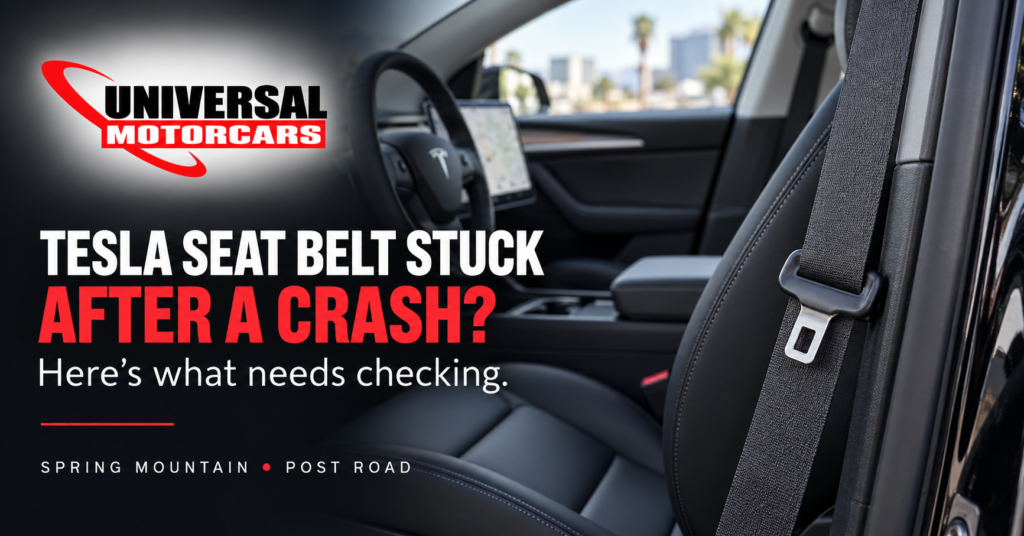
You pull the seat belt, and it won’t come out. Or it clicks into the buckle but hangs loose instead of pulling back. The car may still turn on. The body damage might not even look that bad.
It’s tempting to think the belt just needs to be unstuck.
If a seat belt stopped working properly after a crash, don’t use that seat until it’s been checked. If it’s the driver’s belt, arrange transportation instead of driving the car to the shop. A passenger belt problem also needs attention; moving to another seat doesn’t establish that the rest of the car is safe to drive.
At Universal Motorcars, we look at that belt concern as part of the collision repair. Before anyone gives you a price for “just a seat belt,” we need to understand what happened and what your Tesla’s repair procedure requires.
The belt can look fine and still need attention
The fabric across your chest is only the part you see. Behind it are the retractor that winds the belt back in, its mounting points and, where equipped, a pretensioner. A pretensioner quickly takes up belt slack during a collision.
Tesla’s seat belt guidance calls for belts worn in a collision to be inspected or replaced even when damage isn’t obvious. It also calls for post-collision checks of airbags, pretensioners and associated components.
So “the belt isn’t torn” doesn’t answer the whole question.
No airbags went off. Could the belt still be affected?
Yes. A pretensioner can deploy without an airbag deploying. Tesla’s collision procedures specifically address that situation.
A locked belt alone doesn’t prove deployment, though. Belt retractors also have normal locking functions. The shop needs to establish what happened rather than diagnose it from the symptom alone.
Tell us which seats were occupied, whether those occupants were wearing their belts, and whether you noticed any warnings before the accident. Those details help us investigate the problem without assuming everything started with this crash.
What actually needs checking?
We start with your Tesla’s model, year and VIN to look up the right procedures and parts. Then we explain which checks are needed and get your authorization before the inspection or disassembly begins.
For example, Tesla’s 2025-and-newer Model Y collision guidance includes checks of occupied seats, belts and retractors, belt mounting points, relevant wiring and connectors, and impact sensors near the damaged area. Some checks involve areas hidden behind interior trim.
That’s why a photo of the belt hanging beside the seat can’t settle the repair.
A diagnostic scan helps investigate electronic faults and alerts. It can’t examine fabric, a damaged fastener or the metal where the belt attaches. We need the diagnostic findings and the physical inspection to build the repair plan.
Our Tesla collision repair process in Las Vegas brings those findings together with the body damage. We coordinate the required diagnostic and specialist work as the repair calls for it.
Why would the estimate include more than one seat belt?
This is where an estimate can surprise an owner. One belt feels stuck, but the proposed repair includes another belt, buckles or a control module.
For example, take a 2020–2024 Model Y with a deployed pretensioner after a collision. Tesla’s procedure calls for replacing the restraint control module, the belt with the deployed pretensioner and its buckle, any other belts and buckles that were in use during the collision, and the accompanying fasteners.
That helps explain why we ask who was sitting where. The exact work on your Tesla depends on its procedure and the inspection findings. We’ll walk you through what each item is for and why it belongs on the estimate.
Can the belt just be unlocked or reset?
It’s a fair question, especially when you see companies advertising seat belt resets online.
For a deployed pretensioner, freeing the belt is not the repair Tesla specifies. Its 2024-and-newer Model 3 service guidance requires replacement of affected belts after pretensioner deployment. That guidance also prohibits repairing SRS components or fitting used ones from another vehicle, and specifies new, genuine Tesla replacement parts. SRS means the supplementary restraint system, which includes airbags, pretensioners and related components.
Clearing an alert doesn’t change a replacement requirement. Any diagnostic setup required after a repair is a separate step.
Don’t take the belt assembly apart, spray lubricant into it or try to defeat the warning. These components need proper handling. Let the shop establish the cause and explain the repair before you spend money on a “reset.”
What if insurance only estimated the outside damage?
An estimate prepared from exterior photos may account for a bumper, a door and paintwork without resolving a restraint-system concern. That first estimate may need to change once the vehicle is inspected.
Once your Tesla is here and you’ve authorized the assessment, we document what we find and any additional work needed. We send the insurer the photographs, diagnostic information and manufacturer procedures that support the request.
That request is called an insurance supplement. Our team handles the repair discussions directly with the insurer. If an item is questioned, we explain what supports it and work to resolve the difference.
A part being absent from the first estimate doesn’t establish that it’s unnecessary. Equally, submitting a supplement doesn’t guarantee payment. We explain any potential customer responsibility before you authorize that work.
You shouldn’t have to learn Tesla repair procedures just to explain your estimate to an adjuster. That’s a conversation our team helps handle.
How long will it take—and does this mean the car is totaled?
We can give you a more useful timeline once we know what needs replacing, whether the correct parts are available, and what diagnostic or specialist appointments the repair requires. Insurance review can affect the schedule, too.
The bodywork might be moving along while a restraint-system item is still being resolved. A freshly painted bumper doesn’t mean the car is ready to hand back. Required repairs and checks still have to be completed.
When you ask for an update, ask what the car is waiting on: a part, an inspection, an insurer’s response or a final check. That’s more useful than a pickup date that hasn’t accounted for the remaining work.
A seat belt problem alone also doesn’t tell us whether your Tesla is a total loss. That decision involves the full repair scope, the vehicle’s value and the applicable claim rules. Our guide, “My Airbags Went Off. Is My Car Automatically Totaled?”, explains why even deployed airbags don’t automatically settle that question.
Tell us what the belt is doing. We’ll help with the next step.
You don’t need to know whether a pretensioner fired before calling. “The driver’s belt won’t pull out since the crash” is a useful place to start.
Have these details ready if you can:
- Your Tesla’s model, year and VIN.
- Which belt is affected, what it’s doing and a photo of any warning message.
- Which seats were occupied and which belts were being used.
- The car’s location, your claim number and any estimate you already have.
Call Universal Motorcars before bringing the vehicle over. We can discuss transportation, explain the assessment and authorization, and help coordinate the appropriate next steps.
Spring Mountain
5585 Spring Mountain Rd, Las Vegas, NV 89146
702-754-6774
Post Road
3570 W Post Rd, Las Vegas, NV 89118
702-430-1000