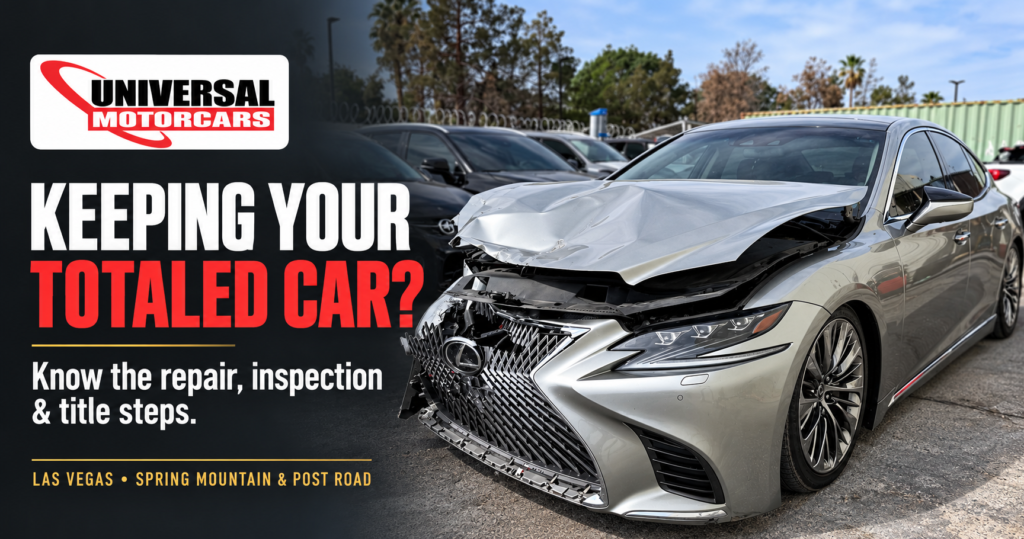
Your car still starts. It moves under its own power. Maybe it’s paid off, you’ve looked after it, and replacing it would mean another monthly payment. Then the insurance company tells you it’s a total loss.
Keeping it can sound like the obvious answer: accept a smaller settlement, get the damage fixed, and carry on driving.
Sometimes that can work. Before you agree, though, find out what it will take to repair the car properly and get it legally back on the road. In Nevada, a salvage vehicle needs repairs, a qualifying professional inspection and DMV paperwork before it can be registered again. A cheaper repair quote doesn’t remove those requirements.
At Universal Motorcars, we want you to understand that part while you still have a choice about what to do with the car.
Why would insurance total a car that still drives?
Because being able to move and being worth repairing are different questions.
A total-loss decision considers the vehicle’s value and repair costs under the applicable rules. It doesn’t depend on whether the engine starts or an EV goes into Drive. Even a car that moves normally can need expensive structural work, replacement restraints or other accident-related repairs.
We explain the repair-versus-total-loss decision in our guide to whether deployed airbags automatically mean a car is totaled. Here, the question is what happens if you want to keep the vehicle after that decision.
First, find out what keeping the car does to your settlement
Ask the adjuster for two written figures: the settlement if the insurer takes the vehicle, and the settlement if you keep it.
Keeping it is usually called owner retention. The insurer generally deducts the vehicle’s salvage value—the value it still has in its damaged condition. Nevada’s total-loss settlement rules require salvage deductions to be itemized and supported, with the settlement basis disclosed in writing. Ask for an explanation if the numbers aren’t clear.
If there’s a loan or lease, involve the lender or leasing company before agreeing. The settlement may be payable to them, to you, or jointly, and keeping the vehicle may require their agreement. An applicable deductible or outstanding loan also changes how much money you actually have available.
Then compare that amount with a realistic repair plan. The first exterior estimate may leave unanswered questions about damage underneath; our explanation of cash settlements and hidden accident damage covers why that matters.
Yes, Nevada requires a professional to inspect and sign off
This is the step people can underestimate.
Under Nevada’s salvage inspection law, the inspection can be performed by a Nevada-registered garage operator, a licensed body shop owner, a licensed rebuilder, or a qualified employee of one of those businesses. It doesn’t have to be a body shop exclusively, but an unlicensed, unregistered repairer cannot provide the required certification just because they fixed the car.
The professional completes Part I of DMV form VP-064, Certificate of Inspection/Affidavit of Vehicle Construction. That signature certifies the vehicle’s mechanical safety and required equipment. The form addresses items including the frame, steering, brakes, lights, airbags and seat belts, and requires repairs to meet the applicable standards.
It’s a safety certification with someone’s name and business information on it. It isn’t simply a receipt showing that repairs were paid for.
A shop being authorized to inspect vehicles also doesn’t mean it will accept every vehicle or certify repairs it cannot verify. Before arranging repairs elsewhere, ask the prospective inspector what documentation and access they’ll need.
Depending on the damage and work already done, that could mean repair photographs, parts records, measurements, diagnostic results or access to areas now covered by trim and panels. Further inspection or corrective work may be needed. A fresh paint job won’t answer those questions.
Get the Nevada paperwork in the right order
For a salvage vehicle five model years old or newer, Nevada requires DMV restoration authorization before repairs begin. That is form VP-209, Authorization for Vehicle Restoration. Arrange that with DMV before someone starts rebuilding the car; it’s a separate step from the inspection after repairs.
After the repairs, the qualifying business completes the safety-inspection portion of VP-064. The owner completes the construction affidavit, and an authorized Nevada DMV representative completes the DMV portion, including vehicle identification checks. Keep repair and parts records throughout the process so you aren’t trying to reconstruct them at the end.
The title terminology matters, too:
- Salvage: the vehicle cannot be registered and driven on public roads in that status.
- Rebuilt: the salvage vehicle has gone through the required restoration and inspection process. Registration still requires the other normal DMV requirements, including insurance. The title brand remains.
- Nonrepairable: this is a different designation. Nevada does not allow these vehicles to be rebuilt for road use.
Nevada also has limited exceptions for certain older vehicles, so confirm the actual title requirements for your car with DMV. Don’t assume that either the word “totaled” or an inexpensive quote tells you the whole title story. The Nevada DMV salvage and restoration guide is the starting point.
“I’ll fix it cheaper and keep the difference.” What can go wrong?
Wanting to save money is reasonable. Keeping a legitimate settlement balance isn’t automatically dishonest. The problem is counting money as savings before you know whether the repair is complete.
Here’s a simple hypothetical example—not a customer story. An owner accepts the retention settlement and gets a low quote to straighten a panel, replace a bumper and paint the car. They assume the money left over is theirs to spend.
Later, the inspection identifies a restraint that still needs attention, or the inspector needs evidence of how a structural repair was performed. The quote never included that work. Now the owner may face additional diagnosis, access work, replacement parts or corrections before the vehicle can pass.
The lower quote may have been lower because it covered less.
You don’t necessarily have to use the same business for every part of the process. But arrange the inspection plan early, and don’t assume another shop will sign the form simply because the repairer says everything is fine.
Also, don’t build the budget around the insurer paying more later. Ask what the total-loss settlement and any release resolve before accepting them. A later repair bill is not an automatic entitlement to another payment.
Include transportation, applicable shop and inspection charges, DMV costs and any required diagnostics or calibrations in your calculation. Ask what remains uncertain. If the plan only works when nothing else turns up, the margin may be too thin.
Keeping a totaled EV deserves a closer look
An electric vehicle can be repairable after a collision. But a car that powers on, moves and looks good after bodywork still needs the appropriate checks for its actual damage.
The expensive questions may be underneath it: the high-voltage battery enclosure, its connections and cooling system, or other components affected by the impact. These need assessment using the manufacturer’s procedures for that vehicle.
For example, Tesla has separate battery underside-damage guidance for Model 3 and Model Y vehicles with non-structural battery packs; structural-pack Model Y vehicles follow a different procedure. The guidance considers more than obvious holes—it includes dents, cracks, leakage and evidence of moisture or heat damage. “It’s a Tesla” isn’t enough information to choose the inspection.
Damage that hasn’t been identified or correctly addressed can cause problems later. That doesn’t mean every rebuilt EV will develop faults, or that a salvage designation proves the battery is damaged. It means a short drive isn’t enough evidence to base the decision on.
If battery damage is suspected, get professional guidance before charging, moving or storing the vehicle. NHTSA warns that physical damage to an EV or its high-voltage battery can lead to immediate or delayed fire and hazardous gas release. Don’t touch exposed high-voltage components; call 911 if there’s smoke, fire or an immediate hazard.
A rebuilt Tesla title doesn’t restore everything Tesla provides
This is worth checking before you keep the car, especially if you rely on Supercharging.
Under Tesla’s current Unsupported Vehicle Policy, a total-loss, salvage or rebuilt vehicle may be classified as unsupported. When that happens, Tesla’s limited warranties and extended service agreements are permanently void, and fast charging—including third-party fast charging—is disabled.
There is an inspection route for potentially restoring fast charging in the United States. Tesla’s published inspection policy describes a High Voltage Safety Inspection followed by a separate Fast Charging Safety Inspection at a Tesla Service Center, at the customer’s expense. Additional repairs may be required.
Passing the high-voltage inspection alone doesn’t restore fast charging. Passing the charging inspection doesn’t restore the warranty or remove unsupported status. These inspections also have specific purposes; they aren’t a blanket guarantee of the car’s overall condition.
A Nevada rebuilt inspection and Tesla’s inspections are separate processes. One doesn’t replace the other. Ask Tesla about the specific VIN, required inspections, likely charges and charging status before you make your decision.
That’s why an apparently affordable salvage Tesla can become an expensive car to keep. The bodywork may be manageable while the battery questions, service restrictions or future repair costs make the overall plan much less attractive.
Before you agree to keep it, get answers to these questions
- What money will I actually receive? Get the retention deduction, any applicable deductible and lender payment explained in writing.
- What repairs are confirmed, and what still needs inspection? Make sure the budget reflects more than the visible damage.
- Who will perform the Nevada safety inspection? Confirm they’ll consider your vehicle, what records they need and how they charge before repairs begin.
- What will it take to insure the rebuilt vehicle? Ask about liability, collision and comprehensive separately. Coverage options can be more limited; don’t assume your old policy will continue unchanged.
- For an EV, what is known about the battery, charging and manufacturer support? An unresolved answer here can change the entire decision.
Keeping the car may make sense when the damage is understood, the repair plan is complete and the costs leave you with a vehicle you can use and afford to maintain. You should also be comfortable owning a vehicle with a permanent title history.
If too much depends on hoping the inspector will approve it, hoping the battery is fine or hoping another payment will arrive, pause before committing. It’s easier to reconsider while you still have options.
Talk through the damage before you commit your settlement
Universal Motorcars handles collision and auto body repairs in Las Vegas, including Tesla body repairs. With the vehicle here and the appropriate authorization in place, our team can assess the damage, document repair needs and explain what further inspection or repair planning is necessary.
We communicate directly with insurers about repair findings. The repair requirements, the insurer’s payment decision and the DMV or manufacturer’s requirements still need to be worked through separately.
Call with the year, make, model, VIN, vehicle location, insurance estimate and proposed retention settlement. If repairs have already started, tell us what was done and bring the records. We’ll explain what assessment we can offer and the next steps for your vehicle before you authorize work.
- Spring Mountain: 5585 Spring Mountain Rd, Las Vegas, NV 89146 — 702-754-6774.
- Post Road: 3570 W Post Rd, Las Vegas, NV 89118 — 702-430-1000.